Ask Arova: What an AI Accounting Assistant Should Show With Every Answer
Share article
“How much do we still have to deposit?” sounds like an easy question until someone asks it in an accounting review.
Deposit against which obligation? For which entity? Does “still” mean deducted but not paid, or amounts already sitting in a prepared challan? Are we discussing this month, the quarter, or everything outstanding? A quick answer can be numerically correct and still send a person to the wrong task.
That is the problem I wanted Ask Arova to address. I’m building Arova, an accounting automation website for Indian funds and real-estate businesses. The assistant is part of that product, so this is a builder’s explanation of its choices. The useful question is whether those choices make accounting work easier to inspect.
An accounting question contains more than a number
Imagine asking a colleague, “Who cost us the most this quarter?” They might pull a supplier report, ask whether you mean fees before tax, and check whether a credit note belongs in the period. Nobody thinks that follow-up is an inconvenience. It is how the colleague avoids answering a different question.
An AI accounting assistant needs the same habit. A list of invoices is evidence about bills. It is not automatically evidence about money paid. An approved bill is not necessarily a posted voucher. A prepared tax document is not proof that the tax was deposited.
These distinctions should survive the move into a conversational interface. Otherwise the conversation is pleasant precisely because it has erased the details that matter.
For me, a useful financial answer has four parts: the amount, the scope, the records behind it, and an appropriate next step. The prose can be short. The evidence should remain reachable.
What Ask Arova actually reads
Ask Arova answers questions about the selected client’s records. Its tools can read bills, supplier history, tax decisions, reports, GST positions and quarterly TDS information. It can also prepare supported documents from those records.
That makes questions such as “Which bills are waiting for review?”, “Why could the TDS on this bill not be decided?” or “Show the bill count by month” reasonable starting points. They have identifiable evidence and a boundary around what is being requested.
It is useful that the interface offers both conversation and direct commands. Slash commands provide structured answers without a model call; broader questions use the model when that capability is enabled and available. Someone checking a familiar number should not have to invent a clever prompt every morning.
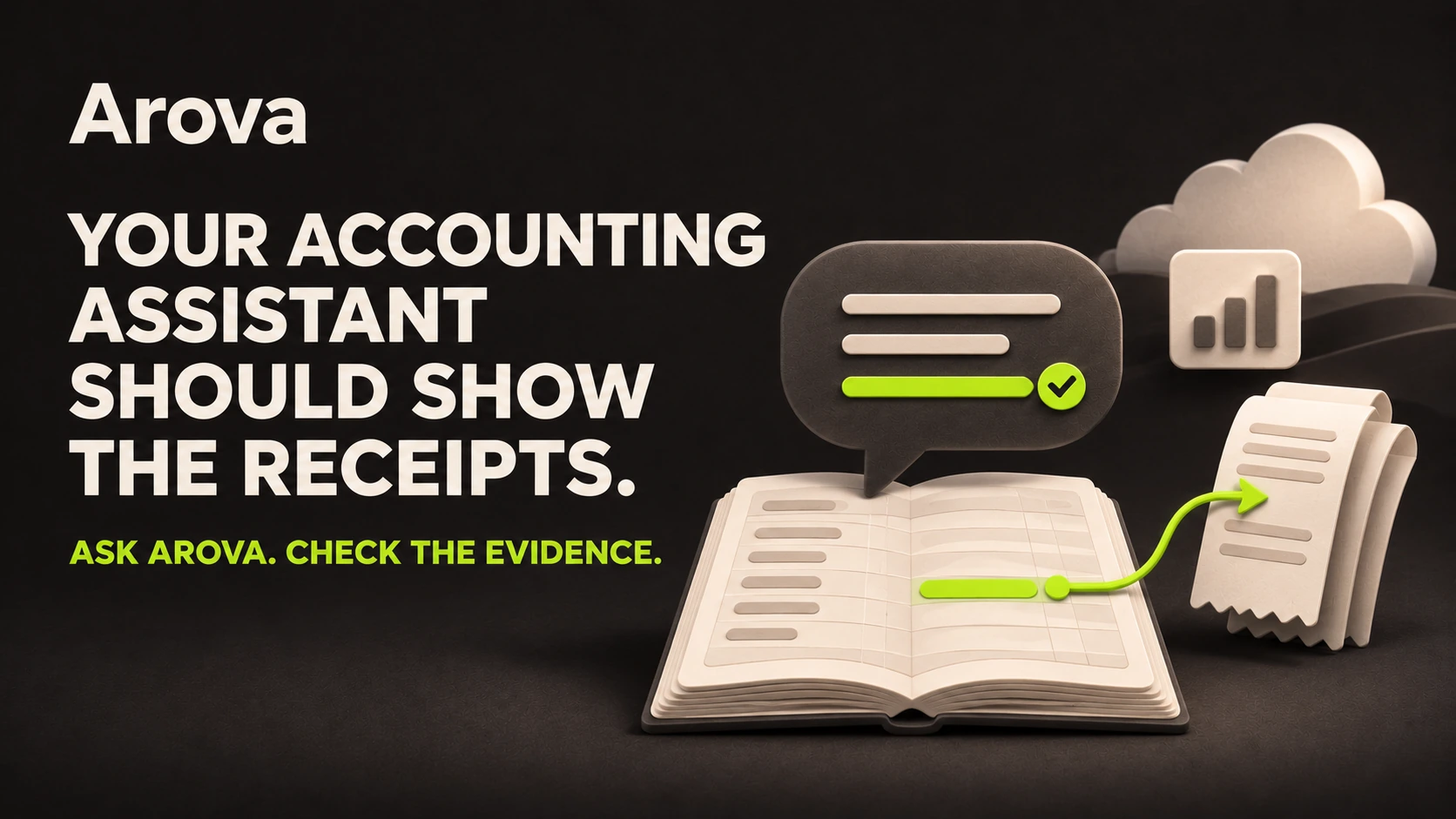
The screen also distinguishes replies and shows the reads behind a model answer. That is a small design decision with real value: an accountant can move from a summary to a source instead of treating the response as the end of the investigation.
A chart should answer the same question as the sentence
Consider this entirely fictional example. A company has four suppliers with recorded fees of ₹4,00,000, ₹3,50,000, ₹2,50,000 and ₹1,80,000 in the selected period. The total is ₹11,80,000. GST, deductions, credit notes and payment status have deliberately been left outside this example.

The chart answers “What fees were billed by these four suppliers?” It does not answer “Who received the most cash?” That would require a payment view and its own definition of the period.
This is where a financial chart earns its place. You can see that the first two suppliers dominate the example, then open their bills to understand why. You do not need a decorative dashboard or a second paragraph restating every bar.
Ask Arova supports bar and line charts for appropriate answers. The chart’s values are checked against figures returned by the tools. If a point is unsupported, the chart is discarded rather than quietly drawing the remaining bars and making an incomplete comparison look complete.
That is a feature I’m particularly pleased with. A chart carries authority. A clean picture should not make an invented amount easier to believe.
Checking figures is useful, but it is a limited check
There is a temptation to describe any evidence check as solving hallucination. I would rather describe what the check does.
Ask Arova’s runtime checks qualifying numerical figures against the information returned during the run. The tools provide calculated totals, so the model can report a total rather than doing accounting arithmetic in its own response. Chart points are checked as well.
This does not prove that every sentence is correct. A genuine figure can be attached to the wrong description. A period can be misunderstood. Small counts do not all receive the same treatment as monetary figures. The check is one layer in a system that still needs clear labels, accessible records and human judgement.
The practical benefit is narrower and valuable: an unsupported large financial figure can be withheld before it becomes a confident-looking answer. If the records do not support a useful answer, the assistant should say what is missing.
That is a better basis for trust than asking someone to trust the model’s tone.
A question is not an approval
“Approve every bill from this supplier” is a sentence an assistant can understand. Understanding it does not establish that the person has reviewed the bills, that the underlying facts are sufficient, or that posting is now appropriate.
Ask Arova reads records. It can guide a person to the relevant screen; it does not approve bills, change supplier facts, post entries or make payments through the conversation. Preparing a document is also different from sending it to a supplier or filing it with an authority.
This makes the assistant useful in a fairly ordinary accounting sequence. Ask what needs attention, inspect the answer, open a bill, examine the reason, and take the action through its established workflow. The conversation shortens the route to the work while preserving the decision itself.
For a finance team, that separation is easy to explain during a handover. The person who asked a question has not accidentally performed a transaction.
Start with questions that have a checkable shape
The best first questions usually contain an object and a period. “Show bills by supplier for October” is easier to inspect than “Tell me how the business is doing.” “Why is this bill waiting?” is more useful than “Fix the accounts.”
For a short evaluation, I would try these requests against a small set of records whose answers are already known:
- Find a particular bill by supplier and bill number, then open the source.
- Explain the recorded reason for a held tax decision.
- Compare bill counts across a specified period, with a chart.
- Prepare a supported supplier statement or TDS summary and inspect the output.
- Ask a question the available records cannot answer and check whether the response acknowledges the gap.
The last request matters as much as the first four. A refusal can be good product behaviour when the alternative is a plausible claim about missing evidence.
Also try two questions that sound similar but mean different things: fees billed versus payments made, or approved bills versus entries delivered to the books. If the assistant makes the distinction visible, you have learned something more useful than whether it can produce a fluent summary.
Documents make a conversation useful after the tab closes
A conversational answer is often a starting point for a review meeting. The person still needs a statement, a schedule or a report they can examine and retain.
Ask Arova can prepare supported documents from its records. This is useful because the underlying question and the output stay close together: someone asks for a particular period, the system uses an appropriate template, and the resulting document can be checked against the source records.
There is a boundary here too. A prepared statement is not a statutory certificate merely because it has a professional layout. A draft supplier letter is not a communication already sent. The output needs a label that reflects what happened.
I prefer this route to making chat the only place where the information exists. Accounting work moves between screens, reviews and files. A good assistant should help that movement rather than demanding that every discussion remain inside a chat thread.
The website should make the product legible before sign-in
The Arova website shows the bill-to-books workflow, example tax reasoning and the Ask Arova interaction. The sample figures are there to explain behaviour; they are not presented as customer outcomes.
I like that this gives a prospective user something specific to inspect. “AI for finance” could describe almost anything. A bill, its tax reason, an approval boundary and a chart tied to records make a much clearer proposition.
For an AIF manager, a real-estate SPV or a CA practice, the important fit question is still practical: are these the records, obligations and accounting systems the team actually works with? A clear website helps someone answer that before spending time on a demonstration.
What I would measure in everyday use
I would measure whether people can find the source of an answer, whether they notice the selected client and period, and how often they have to repeat a question because the first answer used the wrong definition.
I would also record unsupported-answer refusals and review them. A system that refuses everything is not useful. A system that refuses nothing has probably hidden the uncertainty somewhere else. The interesting work is improving the tools and labels so more questions can be answered accurately.
There is room for the assistant to get better without giving it more authority. Better report coverage, clearer follow-up questions and more useful documents can reduce work while approvals remain where accountants expect them.
That is the part of Ask Arova I find promising: it makes asking the books a practical interface, with the evidence still within reach. For a finance team evaluating an AI accounting assistant, that is a concrete thing to test.
For the rest of the workflow, see what happens after invoice extraction and how Arova works with existing Tally books.