AI Invoice Processing in India: The Work That Starts After OCR
Share article
A supplier sends a perfectly readable invoice. The vendor name is clear, the total adds up, and the PDF looks cleaner than most of the documents in the inbox. It can still be the wrong bill to approve.
Perhaps the service belongs to another group company. Perhaps the supplier’s constitution is unknown. Perhaps the purchase includes two different expense heads, or the contract describes the work differently from the invoice. Better OCR will not settle any of those questions on its own.
That gap is the interesting part of AI invoice processing in India. I’m building Arova for funds, real-estate SPVs and their accounting teams, and the design keeps returning to the same issue: a readable document needs to become a reviewable accounting decision before it becomes an entry.
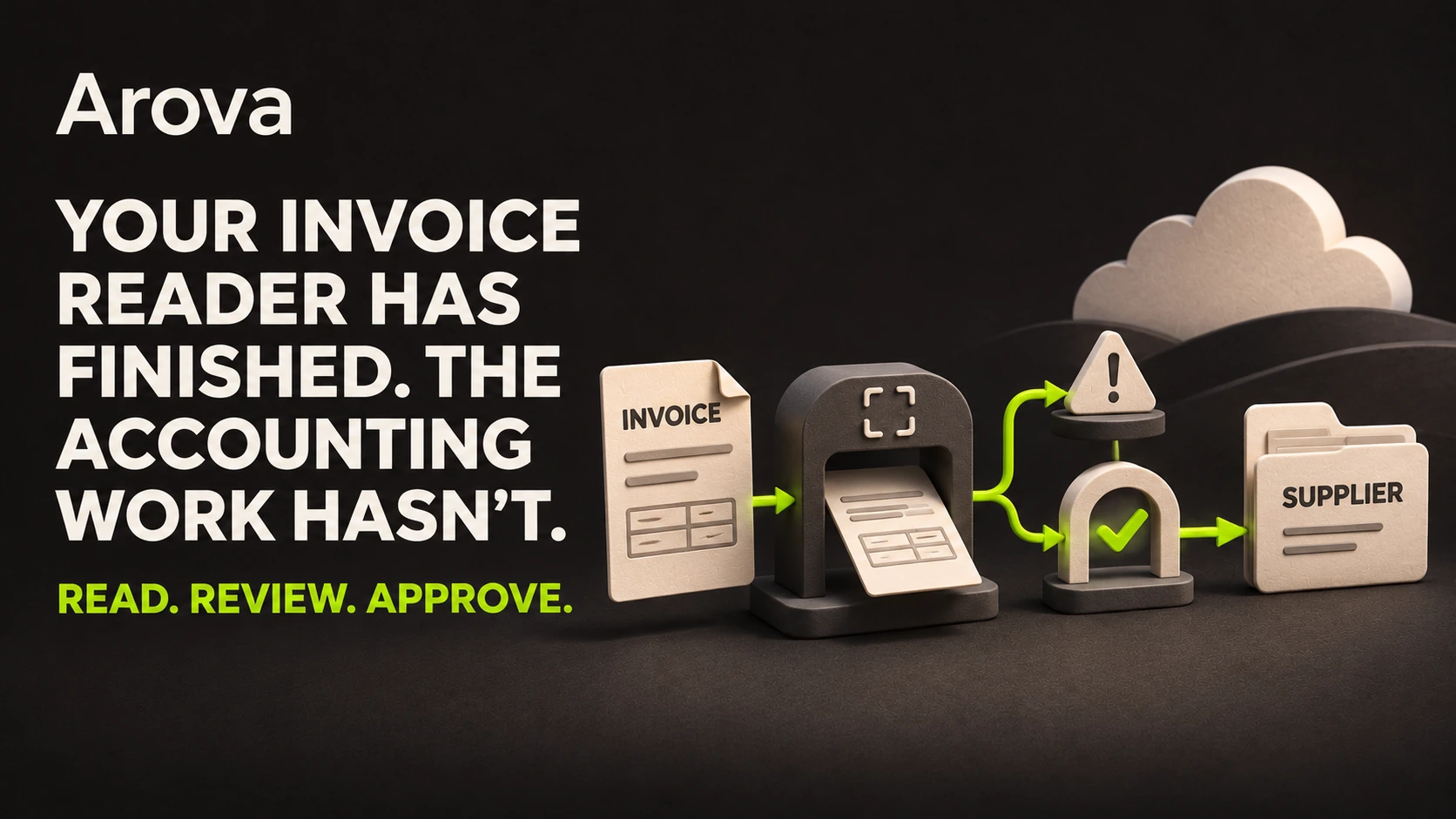
Reading the bill is one job
Extraction should identify what the document actually says: supplier, invoice number, dates, GSTIN, amounts, line descriptions and the relevant supporting details. Where the document is unclear, the uncertainty should remain visible.
This is a good use for a vision model. The input is messy and the layouts vary. A model can recognise a table, connect a description to an amount, and handle a scanned document that would be awkward to parse with fixed coordinates.
But extraction is an observation about a document. It does not establish that the supplier master is correct, that the service was received, that an expense belongs to a particular entity, or that a tax conclusion follows.
The distinction is worth keeping even when the model is impressive. A beautifully extracted mistake is still a mistake, and clean formatting makes it easier to stop asking questions too soon.
Supplier facts deserve their own place
Invoices are repeated documents about an ongoing relationship. If a team has already established a supplier’s identity and relevant facts, every new bill should not begin a fresh argument about who that supplier is.
At the same time, a value printed on an invoice is not always equivalent to a verified fact. A PAN-shaped string can be extracted without proving its current status. A familiar trading name can belong to more than one legal entity. An old tax outcome is not independent evidence of residency.
In Arova, supplier information and supporting contracts sit alongside the bill workflow. A held bill can lead the reviewer to the missing fact instead of producing a tax amount that merely fills the box.
This is one of the product choices I value most. The reviewer gets a question that can be resolved: which supplier fact needs to be established, and where should the evidence go? That is more useful than a generic “low confidence” badge attached to the entire invoice.
A decision needs facts, rules and a period
Indian accounts payable work combines document reading with tax treatment. The nature of the payment, the parties, accumulated activity, the relevant period and any applicable certificate can all affect what needs reviewing.
The Income Tax Department’s TDS compliance guidance is also a reminder that the transition into the Income-tax Act, 2025 depends on the relevant transaction trigger. Replacing an old section label in a template is not the whole job.
Arova separates extraction from the calculation layer. The model reads and classifies; the tax calculation is performed by code using the available facts and configured rules. The decision records its reason, and missing required facts can hold the bill for review.
That does not remove the need for a CA to assess the rule pack and unusual transactions. It makes the inputs and the result inspectable. If the result is wrong, the team can ask whether the document, supplier fact, classification or rule needs correction.
A small queue tells you more than an accuracy percentage
Here is a fictional batch of 100 invoices. Assume 68 have sufficient information for a reviewer to inspect a proposed entry, 17 need supplier facts, 9 need a classification decision, and 6 need the source document clarified.

These are example counts, not an Arova benchmark. They are useful because each category leads to a different action.
The supplier-fact queue belongs to someone who can establish identity or obtain evidence. The classification queue belongs to someone who understands the transaction. The document queue may need a clearer copy or an answer from the issuer. The review-ready bills can move through their normal approval process.
Calling all 32 unresolved bills “OCR failures” would send the team in the wrong direction. Buying a stronger extraction model would not necessarily change any of them.
For a pilot, this kind of queue analysis can be more informative than a single accuracy percentage. You learn where the manual work remains and whether the software helps the right person finish it.
The amount should survive every stage
Take an illustrative invoice with a fee of ₹1,00,000 and separately shown tax of ₹18,000. Its gross total is ₹1,18,000. Those figures are an arithmetic example, not a determination of the applicable GST or TDS treatment for a real supply.
If the reviewer splits the fee across two expense heads, the two allocations should still total ₹1,00,000. If a deduction is determined, the payable and the deduction should reconcile to the appropriate liability. If an entry goes to the books, it should preserve the approved accounting meaning.
This is where ordinary checks matter more than impressive prose. Totals should reconcile. A tax amount should not be accidentally counted as part of the fee twice. A split allocation should not introduce a difference that disappears behind rounding.
A good interface makes these relationships visible before approval. The reviewer should be able to inspect the bill and the proposed accounting entry without mentally reconstructing the whole transaction from a chat response.
An exception should have a route back into the workflow
Many automation demonstrations have a happy path and an error message. Real accounting needs the third part: what happens after someone resolves the error?
Suppose a supplier fact is missing. A person obtains the evidence and updates the record. The bill should become eligible for a fresh decision using that fact, with a clear distinction between the old uncertainty and the new result.
Suppose the bill was filed against the wrong direction or entity. Correcting it should be an intentional action, with enough context to avoid manufacturing a second payable or losing the original document.
Suppose an approved entry cannot reach Tally because the connector is unavailable. That is a delivery problem. Re-reading the PDF or approving the bill again would not be a meaningful fix.
Arova’s separate views for payables, exceptions and postings help keep these different kinds of work visible. I think that is a stronger foundation for accounts payable automation than trying to make every item look processed as quickly as possible.
Approval is where the evidence comes together
An approval screen should bring together the source document, supplier identity, amounts, tax reason, coding and the entry being proposed. These are connected pieces of a decision, not independent form fields.
The reviewer needs to know what changed, what remains uncertain and what will happen next. “Approved” should not be used interchangeably with “paid,” “filed” or “confirmed in the external books.”
In Arova, nothing reaches the client’s books without human approval. Ask Arova can help a person find and understand a bill, but the conversation itself does not approve it. That boundary is easy to explain, and it avoids a surprisingly large amount of ambiguity.
The point of automating the preparation is to give the reviewer a better starting position. If the person still has to collect the same evidence from four tabs, the automation has saved keystrokes while leaving most of the actual work intact.
Test the awkward documents deliberately
A useful evaluation set should include ordinary clean bills, but it should also contain examples that make the workflow reveal its assumptions.
Try a duplicate PDF with a different filename. Try two suppliers with similar names. Try an invoice with several expense lines. Try a document belonging to another entity. Try a credit note, an amended invoice and a bill whose supporting contract changes how the service should be understood.
For each item, record what the system read, what it proposed, what it refused and what a reviewer had to do. Keep those categories separate. A correct refusal is different from an extraction error; a convenient approval screen is different from a correct tax calculation.
You can also ask a practical handover question: could a second accountant understand this decision next month without asking the person who originally processed it? If the answer is yes, the system has preserved something valuable.
What this changes about buying invoice automation
I would ask a vendor to demonstrate the whole route with a small sample of representative documents: intake, extraction, supplier facts, classification, tax determination, coding, approval and delivery to the books.
Then I would interrupt the route. Remove a required fact. Make the accounting connection unavailable. Send the document twice. Ask for the source of a figure. The recovery behaviour tells you whether the product understands the job it is being trusted with.
The Arova website does a good job of making that route visible: a bill arrives, the reasoning is shown, a person reviews it, and an approved entry goes to Tally or ERPNext. As its builder, I find that a more useful promise to make than a dramatic percentage without a defined test set.
AI invoice processing becomes interesting when it reduces the distance between a document and a defensible entry. The strongest result is a bill an accountant can approve with less reconstruction, and a held bill whose next step is obvious.
For the surrounding workflow, read AI alongside Tally, Ask Arova’s evidence-first answers, and the 2026 TDS transition.