A False Alarm Nearly Drowned Jane Street's Data Centre. Follow the Failure Chain.
Share article
A false smoke alarm. Cooling switched off. Pressurised sprinkler pipes above a room full of machines that were getting hotter.
Michael Bacarella’s 10 November 2026 account of an earlier Jane Street incident has a better opening than most reliability presentations. It also has an important date distinction: this is a newly published recollection, not a report that Jane Street’s present data centre nearly flooded this week.
The story is useful because each protective system makes sense when considered separately. The dangerous part is what happens when their responses are connected.
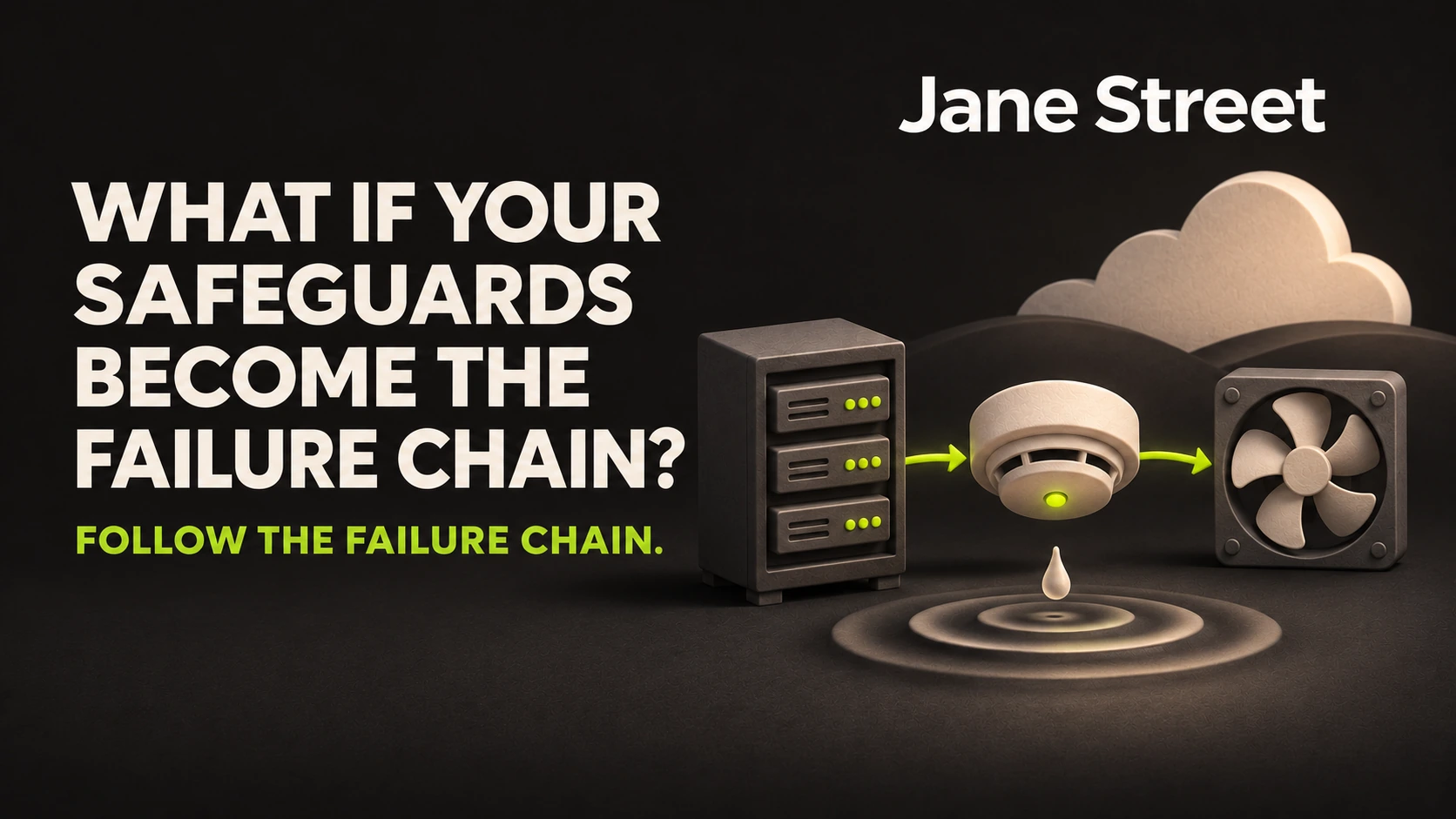
The failure chain in the firsthand account
In Bacarella’s account, contractor dust triggered an alarm. The response pressurised sprinkler pipes and shut down cooling. Heat from running equipment then created the risk that the sprinkler heads would activate. He describes rushing to disconnect equipment, with a reported peak reading of 143.6°F, and says the systems were operating again the next morning.
That is the author’s recollection. I have not independently verified the incident, its date or the reported temperature, and it should not be used to describe the firm’s current facilities.
One phrase in the account identifies the monitoring problem:
a generalized cooling failure
The phrase is Bacarella’s. A pattern across machines could indicate a different problem from an isolated hot server, and the response needed to recognise that larger state.
Local safety can create a system-level surprise
A protective action can change the conditions another component relies on. Stopping airflow may be appropriate for one hazard while reducing cooling makes a different threshold more likely to be reached.
The general engineering question is which assumptions are invalidated when a protection activates. Does an isolation step remove monitoring? Does a failover path depend on the same power source? Does a recovery action disable the evidence needed to determine whether it succeeded?
These questions are often easier to ask with a diagram than with a long list of individually sensible controls. Draw the inputs, responses and dependencies, then follow the state changes in order.
The useful lesson is not that a particular protective technology should be removed. It is that the connected behaviour deserves a test and an explanation of its own.
The warning may exist at the wrong level
An individual machine can be warm for an ordinary reason. A fleet warming together can suggest a shared dependency problem. The same pattern appears in application operations.
One invoice extraction failure may be a bad scan. Many simultaneous failures may be an unavailable model provider. One delayed posting may be a particular record; a queue growing across clients can indicate a connector or shared-service problem.
An alert designed only around individual records can make the shared condition hard to see. Conversely, a broad aggregate can hide the one exceptional item with a large consequence.
A useful operational view preserves both levels. The team should be able to recognise a correlated pattern and then open the affected records. Neither the dashboard total nor the individual error message is sufficient on its own.
A backup is one ingredient in recovery
Suppose a team says it can restore a database in 45 minutes. That may be a real and useful measurement. It does not necessarily describe how long it takes for the business workflow to become trustworthy again.
The restored data may need validation. Pending jobs may need replaying. External systems may already have accepted actions that the restored database does not remember. Someone needs to reconcile those effects before normal operation resumes.
Here is a fictional planning exercise: 45 minutes for restoration, 15 for validation, 20 for replay and 25 for reconciliation. Run sequentially, those stages total 105 minutes.

These times are invented assumptions. They are not measurements from the Jane Street story, an Arova recovery result or a claim about an appropriate recovery target for every business.
The example shows why the name of the measurement matters. “Restore time” and “time until the workflow is safe to resume” can describe very different things.
External effects make recovery harder
Imagine a bill whose approved entry was accepted by an external accounting system. A connection failure then prevented confirmation from reaching the application. The record now has an uncertain delivery outcome.
Restoring an older database snapshot cannot tell you that the external entry vanished. Blindly replaying every pending record could create another effect if the workflow does not preserve a stable identity and a way to reconcile it.
The recovery needs to establish what the destination accepted and which local records describe the same logical work. The important evidence includes the approved subject, its identifier, the attempted action and the destination’s result.
This is why a reliable workflow needs meaningful states rather than a single processed flag. Uncertainty should remain visible until the team has the evidence to resolve it.
Financial correctness is more than service availability
A service can respond to requests while its records still need reconciliation. That is an awkward but important distinction in financial software.
The team may need to confirm entity scope, period completeness, balances, pending approvals and external posting outcomes. A green health endpoint does not establish those properties.
For an exercise, define the business acceptance checks before the incident. Which totals must agree? Which records must not be duplicated? Which actions require a person before they resume? Which evidence proves the destination has the expected entries?
This makes the recovery test more useful than a demonstration that the process starts again. The product should return with a state its operators can understand, including any explicitly unresolved items.
What this makes me value in Arova
I’m building Arova, and the part I find particularly useful here is its visible separation between a bill, a decision, approval and delivery to Tally or ERPNext.
If an entry is waiting for the connection, the accountant should see a delivery issue. If supplier facts are missing, the next step is a different kind of work. Treating both as a generic failure makes a recovery queue harder to operate.
Arova’s posting outbox and duplicate checks are intended to help keep repeated attempts attached to the same logical work. Those mechanisms still deserve end-to-end tests and an honest treatment of uncertain outcomes.
This is not a claim that Arova has a particular disaster-recovery certification, a measured recovery-time guarantee or protection from every failure. The useful product benefit is that the accounting history remains something a person can inspect and reconcile.
Run the exercise with a second operator
A recovery plan can work beautifully when the person who wrote the system is standing beside it. A more revealing test asks someone else to follow the recorded process.
Can they find the correct backup and credentials through the authorised route? Can they identify the active entity and period? Do they know which jobs may be replayed and which require the destination to be checked first?
Most importantly, can they tell the difference between a completed step and an assumed one? A note saying the data looks normal is weaker than a named reconciliation with a retained result.
The exercise may expose documentation work rather than code work. That is still a valuable result. A system that depends on the founder remembering the right sequence has an operational dependency, even if every individual service is reliable.
Make the near misses useful without turning them into theatre
A vivid incident story can encourage the wrong response: copy the exact fix from a different environment and declare the lesson learned.
The better response is to identify the class of dependency and look for its equivalents. What can fail together? Which protective action changes another subsystem’s assumptions? Which part of recovery depends on evidence outside the restored database?
Retain the results of that review. A short diagram, an explicit acceptance check and an operator who can follow the recovery route are more useful than a dramatic slide about a disaster that happened elsewhere.
The reason this Jane Street recollection is worth reading in November 2026 is not that it proves a current firm unsafe. It makes an enduring systems problem memorable: a collection of sensible components still needs a coherent account of how the whole thing behaves.
Related: reliable delivery into Tally and AWS Emulator’s role in repeatable tests.