GSTR-2B Reconciliation: Why a Matched Invoice Still Needs a Decision
Share article
“Ninety-five per cent matched” is a pleasant number to put on a GST dashboard. It becomes less reassuring when the remaining five per cent includes the largest invoice of the month, or when “matched” means that two document numbers look similar.
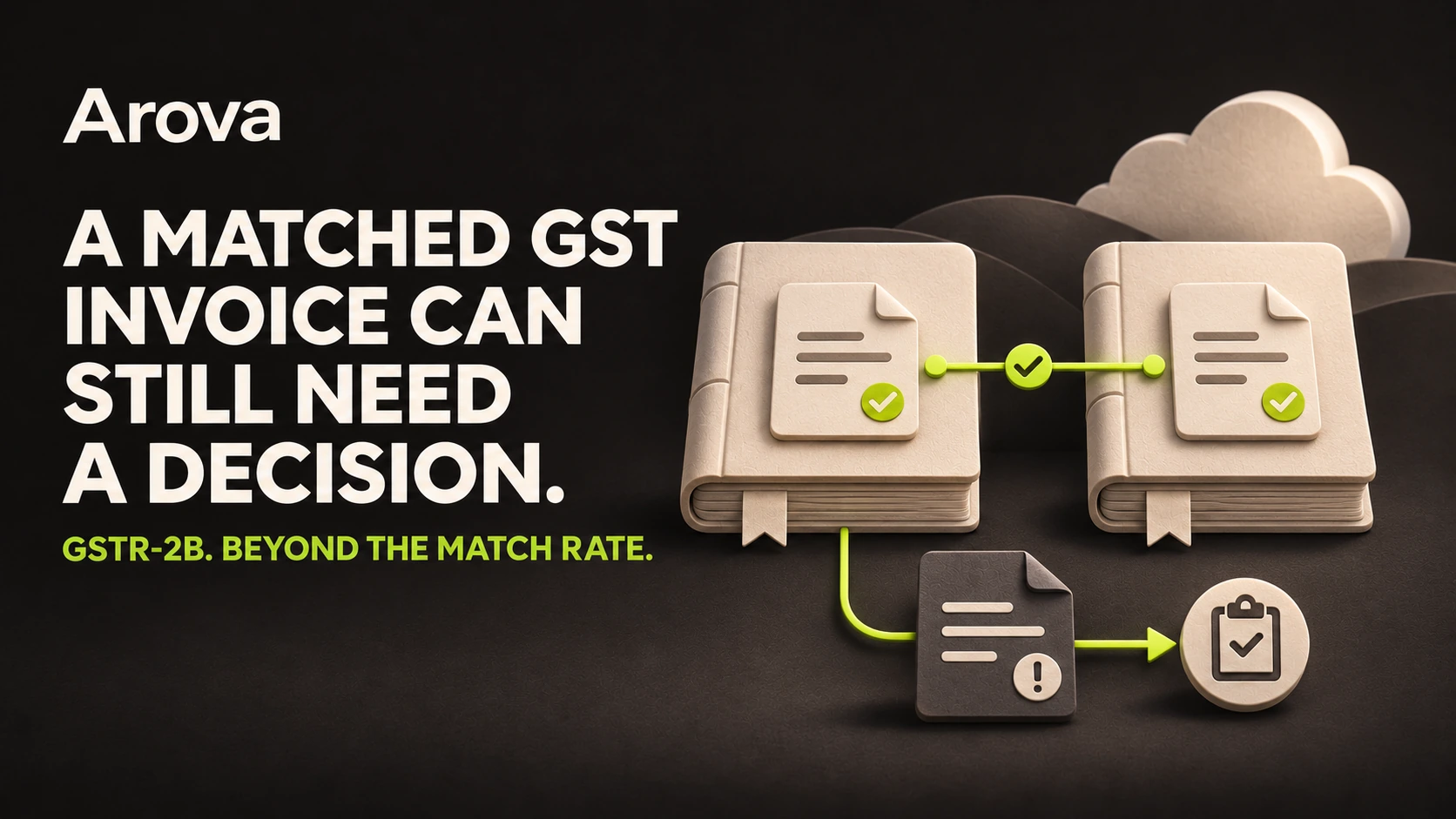
A useful GSTR-2B reconciliation should leave the accountant with a clearer set of decisions. Which bills need a supplier follow-up? Which differences belong to the books? Which documents need an eligibility review even though they appear in the statement?
This is a workflow article, checked against GST Portal guidance on 12 November 2026. I’m also building Arova, whose GST workflow includes comparing a downloaded GSTR-2B file with recorded bills. The interesting part is what the reviewer can do with the differences afterwards.
What GSTR-2B can and cannot establish
The GST Portal’s Invoice Management System advisory explains how supplier records and recipient actions feed into GSTR-2B. Separately, the Ministry of Finance’s September 2025 GST FAQ explains that input credit remains subject to the applicable conditions and restrictions. These are foundational sources, not newly announced November 2026 changes.
That is a useful distinction for software design. A document’s presence in GSTR-2B is evidence for the reconciliation. It is not a complete eligibility decision for every recipient and circumstance.
The practical implication of the portal’s IMS guidance is to retain the statement version and relevant portal status being used, rather than treating an old downloaded file as a permanently current view.
The review should therefore connect three things: the source bill, the purchase record and the statement evidence. The final accounting or tax action still needs the relevant facts and professional judgement.
Build the comparison around the document identity
Supplier GSTIN and invoice number are natural starting points for finding a corresponding record. They are much stronger than matching only a supplier name and a rounded total.
Even then, document identity needs care. Invoice numbers may contain slashes, spaces, letter prefixes and leading zeros. A comparison can normalise harmless presentation differences, but it should retain the original values for inspection.
If the tool transforms “AB/001” into “AB1,” the reviewer should be able to understand that transformation. A matched result should not erase the evidence used to create it.
Arova matches the imported statement against its bills using supplier GSTIN and invoice information. That is a useful starting point because a difference can be connected back to an actual record rather than becoming a row in a detached spreadsheet.
A reconciliation needs more than two buckets
Consider a fictional review population of 100 documents across the books and statement. Eighty-two are aligned on the fields being checked, nine are in the books without a corresponding statement entry, five appear in the statement without a recorded bill, and four have a tax-amount difference.

These counts are an illustrative example, not Arova’s match rate or a claim about a typical business.
Each group deserves a different next step. For a book-only invoice, the team needs to investigate the supplier and period information. For a statement-only item, it needs to locate the underlying document and establish whether it belongs to the entity. A tax difference needs comparison of the actual amounts and any related adjustments.
Even the 82 aligned records may require other checks. The match is a statement about the comparison performed, not an instruction to claim every rupee automatically.
This is why a headline match percentage is a poor substitute for a review queue. The categories explain the work that remains.
A ₹1,800 difference should be easy to explain
Suppose a fictional bill in the books carries ₹18,000 of tax while its corresponding statement record shows ₹16,200. The difference is ₹1,800.
That arithmetic is easy. The accounting task is establishing why the records differ. Was the document entered incorrectly? Is there a related adjustment? Are the records actually describing the same supply? Does the team have the latest supporting document?
The useful reconciliation screen shows both source values, their document identities and the relevant evidence. It should not simply replace one with the other to produce a clean match.
I would want the reviewer to leave a short explanation and a next step. If a supplier correction is needed, retain the request and the later response. If the books need correction, preserve the accounting history rather than pretending the original value never existed.
Missing from the statement is an investigation category
An invoice in the books with no corresponding statement record can have several explanations. The first task is to establish the correct entity, supplier identity, document number and period before deciding what follows.
A well-designed workflow gives the reviewer enough detail to make a precise supplier enquiry. “Please check your filing” is less useful than identifying the invoice, recipient and amount that the team cannot reconcile.
The product should also retain unresolved items across review cycles. Otherwise the accountant can spend time investigating a difference in one month and rediscover the same difference later with no visible history.
This is a practical place for automation to help. It can organise the evidence and prepare a consistent follow-up, while the accountant decides the appropriate treatment and verifies the eventual resolution.
A statement-only document needs a source
A document appearing in a statement without a corresponding purchase record deserves attention too. It may point to a missing bill, an unfamiliar supplier description or an item that needs to be queried.
The wrong shortcut is to manufacture a purchase solely to make the reconciliation agree. The reviewer should establish the underlying transaction and whether the document belongs to the entity.
The correct next step may be asking the internal team for the bill or asking the supplier for clarification. The system can help by keeping the statement evidence attached to the question and making the unresolved status visible.
This is another reason to distinguish a document-matching tool from a complete accounts payable workflow. The match identifies the discrepancy. The accounting workflow gives someone a place to resolve it.
Credit notes and changes need their own trail
A review should account for related documents rather than treating every row as an unrelated positive invoice. Credit notes, amendments and corrected documents can change the relationship the accountant needs to understand.
For the software evaluation, ask the vendor to open an actual example and show the source relationship. Can the reviewer see which original document a note relates to? Are the original and revised values distinguishable? Does the comparison preserve the evidence rather than merely netting everything into one unexplained number?
The specific treatment depends on the current rules and facts. The product’s job is to make the relationship visible enough for that treatment to be assessed.
An apparently simple reconciliation can otherwise hide several versions of the same commercial event. A clean total is not proof that those versions have been handled correctly.
The part of Arova I find useful here
Arova’s GST workflow lets a team upload the GSTR-2B JSON from the portal, compare it with recorded bills and inspect missing or mismatched items. It can also prepare supplier follow-up material.
What I like about that arrangement is the connection back to the bill. The difference is not the final output; it is the start of a review with a document and a counterparty attached.
There are clear boundaries to preserve in a demonstration. An imported comparison is not a live GST Portal integration, a prepared letter is not a letter already sent, and a reconciliation report is not a filed return.
Being clear about those boundaries makes the product easier to use responsibly. The team can see which tasks have been assisted and which decisions or portal actions still belong to a person.
Choose measures that reward the right work
For a reconciliation pilot, measure more than how many rows the algorithm matched. Track the value of unresolved differences, the age of open questions and whether each exception has an owner and evidence.
Also inspect false matches. A high match percentage is not valuable if it combines different documents or hides material differences behind an overly generous tolerance.
You can measure review effort without inventing a dramatic savings claim. Count how often an accountant has to search outside the tool for the source bill, re-enter a document number or reconstruct an earlier supplier conversation.
Those observations help distinguish useful automation from a nicer presentation of the same manual work. They are also specific enough to guide a product improvement after the pilot.
A short review sequence that can survive next month
Confirm the client and statement period first. Retain the downloaded file and note which purchase records are included in the comparison. Run the match, then review exceptions by cause and materiality.
For each unresolved item, record the next evidence needed and the person responsible. Keep any supplier communication connected to the invoice. Have the appropriate reviewer assess the treatment of items being carried forward.
Before treating the review as complete, inspect a sample of matched records as well. A match should mean something defined and reproducible, not simply that the tool found a plausible partner for every row.
That is the kind of GST automation I want Arova to provide: less time gathering evidence, a clearer queue of decisions and a record someone else can understand. The website’s bill-to-books explanation is a useful place to begin evaluating that fit.
Related: GST rate changes and source dates, reviewing invoices after OCR, and month-end across separate entities.