Gemini 4 Carbon Starts at $2. Your Agent's Bill Doesn't.
Share article
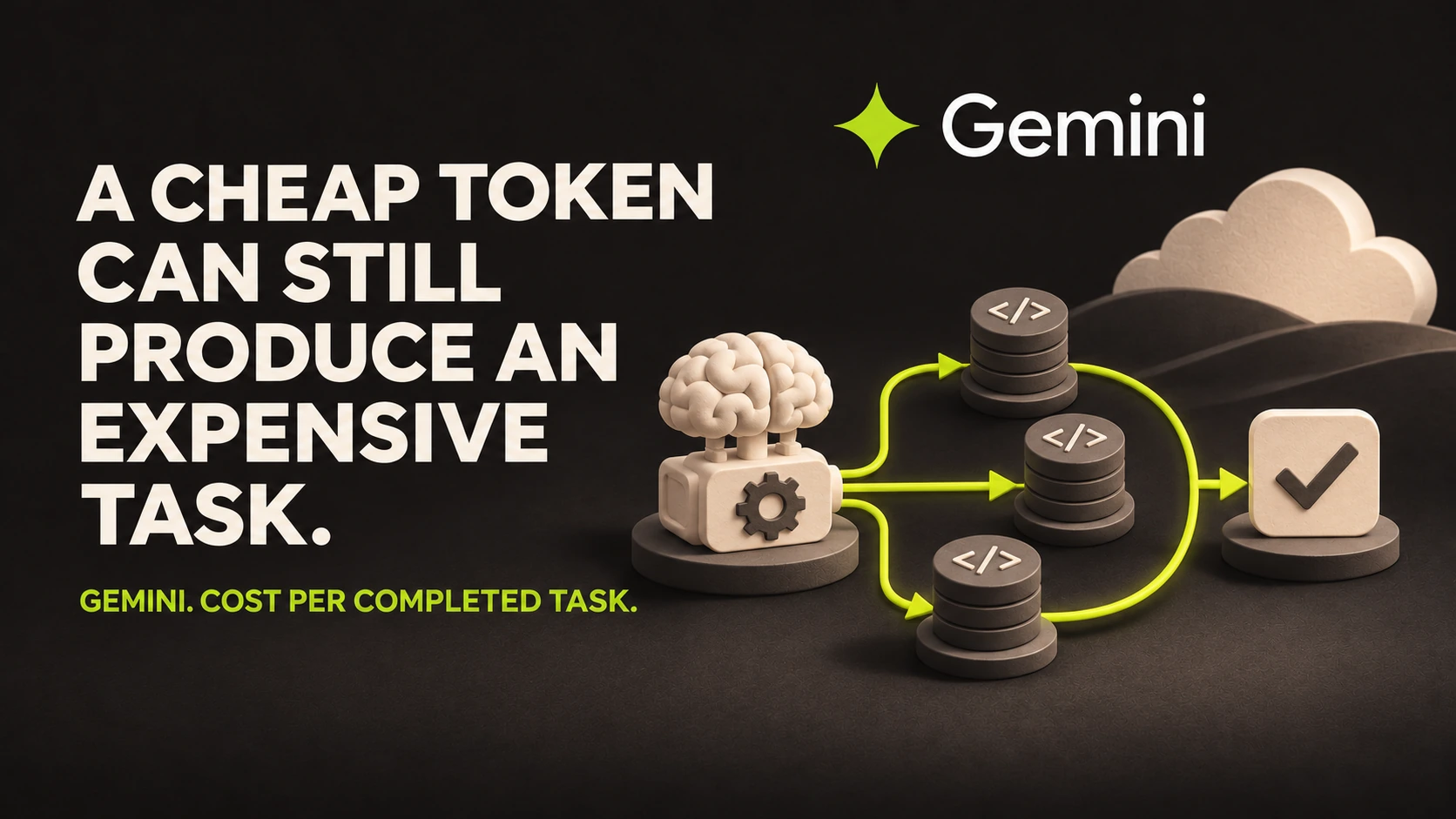
The $2 in Gemini 4 Carbon’s introductory pricing is per million input tokens. It is not the price of an agent completing your task, and it tells you very little about a workflow that repeatedly reasons, calls tools and starts another attempt.
Google made Carbon broadly available on 10 November 2026. The release is a useful moment to revisit a mistake that keeps surviving every model generation: comparing a token price with a business outcome as if they were the same unit.
The model can be capable and the workflow can still have poor economics. The reverse can also be true: a more expensive call can be worthwhile if it produces an accepted result with less recovery work.
The price card, with the units attached
Google’s availability announcement lists introductory pricing of $2 per million input tokens and $10 per million output tokens. Its original announcement also states post-introductory prices of $4 and $20 respectively. These are published terms to verify for the model, access route and date you actually use.
The availability post describes Carbon tackling demanding work while:
using more tokens than Argon
That short quote is from Google’s own explanation of the model’s intended role. More effort can produce a better answer, but it also makes the amount of work part of the cost calculation.
Nothing in this article is a hands-on Carbon benchmark. The worked figures below are arithmetic scenarios using the stated rates, not observed token consumption.
An output-heavy task changes the comparison
Assume one task uses 100,000 uncached input tokens. At the stated introductory input rate, that contributes $0.20.
If it then uses 10,000 billed output tokens, the output contributes $0.10 and the total is $0.30. At 50,000 output tokens, the total becomes $0.70. At 200,000, it becomes $2.20.
Using the stated post-introductory rates for the same assumed quantities doubles those figures to $0.60, $1.40 and $4.40.

The examples exclude tools, additional calls, caching, storage, taxes and other applicable services. Check the provider’s current treatment of all billed token categories rather than assuming the final text visible in the interface is the whole output bill.
The point is not that these particular amounts are alarming. It is that output length and repeated work can change the cost even when the headline input price remains the same.
The task rarely consists of one call
A coding agent may inspect a repository, propose a patch, run a build, inspect an error and revise the patch. A research agent may retrieve several sources, reject one, search again and rewrite the answer.
Each loop has an economic purpose if it improves the chance of an accepted result. It becomes wasteful when the system repeats work without gaining relevant evidence.
For evaluation, retain the sequence rather than only the final response. Count the attempts, the material retrieved again, the tool calls and the reason the workflow decided to continue.
This can reveal a design problem that a cheaper model does not fix. If an agent cannot recognise success or cannot access the evidence it needs, a low token price can simply make an unproductive loop look affordable for longer.
Cost per accepted result is a better question
Suppose one route costs an illustrative $0.30 per attempt but needs three attempts and a manual correction. Another costs $0.70 and produces a result the reviewer accepts immediately.
The comparison needs more than the first invoice from the model provider. It needs a defined acceptance standard, the proportion of tasks meeting it, and the human work required to finish the rest.
That does not mean the stronger model should handle every request. A simple extraction, lookup or routing step may not benefit from the same reasoning effort as a difficult investigation.
The useful architecture lets different tasks use different levels of effort while preserving a shared definition of completion. The cost becomes explainable because the extra work has a visible reason.
Decide what makes the loop stop
“Keep working until it is right” sounds helpful and is an incomplete control. The agent needs a way to determine whether the required result exists.
For a code change, that might include a relevant test and an inspection of the resulting behaviour. For an accounting answer, it might mean retrieving a specific report and stating its period. For a document, it might mean satisfying a checklist whose items can be inspected.
A budget limit is useful too, but it should produce an honest incomplete state. Stopping at a spending cap should not turn into an invented success message.
I would want to know what the workflow records when it stops: the evidence obtained, the unresolved question and the next step for a person. That makes a bounded attempt useful even when it does not finish the whole task.
Do not make an expensive model do cheap arithmetic badly
There are tasks where a model’s flexibility is valuable and tasks where a normal calculation is easier to inspect. Combining them indiscriminately creates both cost and reliability problems.
If the application already has structured amounts, it can total them with code and return the total to the assistant. Asking the assistant to reconstruct the sum from a paragraph adds another opportunity for error without necessarily adding useful judgement.
Likewise, a fixed rule with established inputs can remain a calculation. A model may help read the document or explain the result, while the calculation retains a reproducible path.
This is not a contest between models and conventional software. The workflow gets better when each part has a clear job and the evidence from one part is preserved for the next.
The accounting product lesson
I’m building Arova, where the model reads bills and the configured tax calculation runs in code. The result carries a reason, and required missing facts can hold the bill for review.
I particularly like that this gives the accountant a decision to inspect rather than another long explanation to interpret. The supplier fact, the rule and the proposed entry remain connected.
The same principle applies to Ask Arova: the assistant retrieves records and totals, with numerical checks on qualifying figures and charts. A person still approves through the accounting workflow.
This is a product design example, not a claim that Arova currently runs Carbon or has measured savings from it. The relevant benefit is a disciplined division of work that can make both the result and its cost easier to understand.
Run a small evaluation before multiplying the workload
Pick representative tasks and define what an accepted result looks like before running them. Include a few tasks that should stop because the evidence is missing.
For each run, retain model and tool usage, the number of attempts, the final result and the reviewer’s decision. Separate failures caused by the model from failures caused by unavailable data, an unsuitable tool or a vague objective.
Then compare routes on the same tasks. A higher-priced model may justify itself on the difficult slice and add little on the routine slice. A stronger retrieval tool or clearer acceptance test may improve both routes.
Keep the applied price and evaluation date with the result. Otherwise a later comparison can confuse a temporary introductory rate with a change in how efficiently the workflow completes the job.
You do not need a large dashboard to begin. A small table with transparent definitions can reveal more than an average token cost collected across unrelated tasks.
Read the launch headline, then price your actual job
Carbon’s launch matters because it expands the options available for demanding work. That is a reason to evaluate it against a job whose quality can be assessed, not to assume the introductory price defines the economics of every agent.
Keep the units visible: input tokens, billed output, tool work, attempts and accepted results. Preserve the distinction between a provider’s reported capability and what your own workflow has demonstrated.
An agent’s bill becomes manageable when the additional reasoning has a purpose and a stopping condition. The useful question after “How much per million tokens?” is “How much work did we accept, and what did it take to get there?”
Related: Google’s bounded Decisions API and why agents need a fast test environment.