A Disputed Invoice Is Not One Cash-Flow Assumption.
Share article
Consider a fictional weekly review. The customer says part of the invoice is wrong. The sales manager says the relationship is fine. The cash forecast still shows the full amount arriving on Friday. Each statement may describe a different piece of the situation, but the forecast has quietly turned uncertainty into a date.
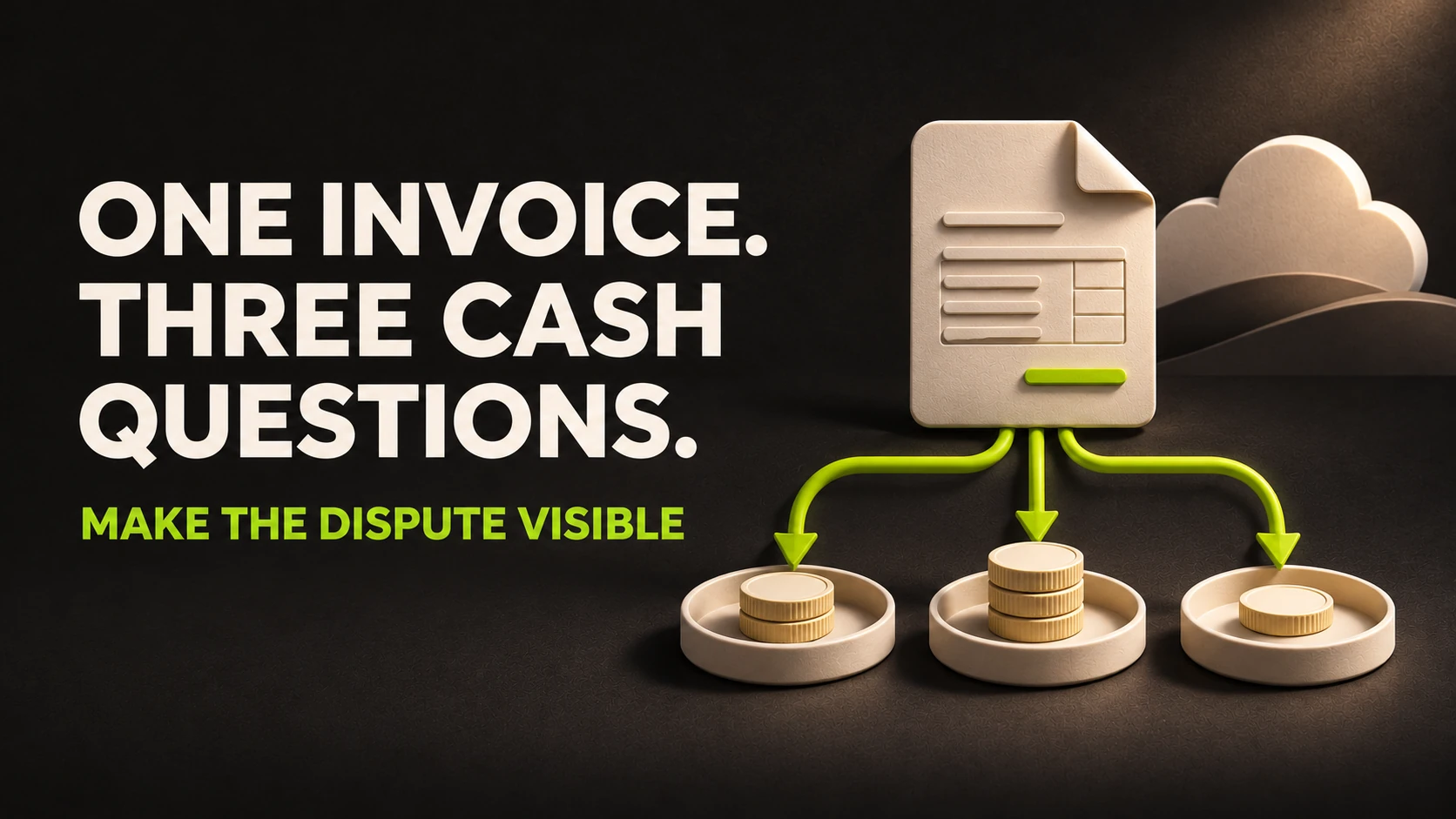
A disputed invoice needs three separate questions: what amount is being discussed, when could cash actually arrive, and what must happen next to change the situation? Keeping those questions separate makes the collection work more precise and the cash plan more honest.
Forecast receipts rather than invoice dates
The British Business Bank's guide to cash-flow forecasting, reviewed on November 18, 2026, places receipts in the period when cash is expected to reach the bank account. That is a useful starting distinction: an invoice's date or amount does not establish the timing of its collection.
This article develops an original working method for one uncertain invoice. It is general business planning, not advice on revenue recognition, impairment, debt enforcement or a legal right to withhold payment. Those questions require the relevant facts, jurisdiction and professional review.
The forecasting problem can be addressed without resolving all of them immediately. A team can show what it knows, identify the contested part and make alternative timing assumptions visible. What it should avoid is letting one optimistic date stand in for several unanswered questions.
Break the invoice into decision-relevant parts
Suppose a fictional consultancy issues a £12,000 invoice. In this illustrative case, the customer confirms acceptance of £8,000, questions £3,000 of additional scope and says it needs supporting documents for the remaining £1,000. Ignore tax and all other charges for the example.
Those are three different working states. The £8,000 still needs a reliable payment expectation. The £3,000 requires a commercial discussion about scope. The £1,000 requires a document response. Labelling the entire invoice “disputed” hides work that can proceed separately.

The chart partitions the fictional £12,000 invoice into those three amounts. It does not show probabilities of collection, a legal assessment or actual customer data. Acceptance of an amount is not confirmation that the money has arrived, and a request for documents does not establish whether the underlying claim is valid.
Use the customer's actual wording and evidence when building a real case. If the customer has not clearly accepted a portion, do not mark it accepted merely because the account manager believes it should be uncontroversial.
Separate the commercial owner from the cash assumption
The person best placed to resolve a scope disagreement may not be the person maintaining the cash forecast. That is reasonable. The problem arises when the forecast owner cannot see what the commercial owner is assuming.
Give the case one accountable coordinator and identify the people needed for each decision. Delivery may supply evidence of completed work. Sales may discuss the scope. Finance may confirm the invoice details and track receipts. The coordinator keeps those actions connected without pretending to decide every issue personally.
Record the next action as something observable: send the signed change request, obtain the customer's response to a line item, or confirm whether an accepted portion has entered the payment process. “Chase customer” is too broad to explain what is expected to change.
Then link the cash assumption to the action. If the forecast depends on acceptance of the additional scope, state that dependency. A date without its condition invites the next reviewer to mistake a commercial hope for a scheduled receipt.
Use scenarios when timing is unresolved
For the fictional case, one scenario might assume the £8,000 accepted portion arrives in the next weekly period, with the other amounts excluded until their issues are resolved. Another might move that receipt one period later. A third might assume no receipt during the short planning horizon.
These are stress cases, not estimated probabilities. They show the decisions that become necessary if timing changes. Do not average them into a single “expected receipt” unless there is a defensible method and evidence for the weighting. An invented 70% collection probability only makes uncertainty look more scientific.
Keep the rest of the cash plan fixed while examining the invoice's timing. That lets the team see its contribution to a possible gap. Once the effect is understood, wider scenarios can consider other uncertainties without confusing their causes.
The earlier discussion of customer concentration considers dependence on a customer across the business. This method works at a smaller scale: one invoice can contain several different uncertainties, each with a different action and cash consequence.
Ask for evidence that changes the next decision
A large attachment bundle can make a dispute harder to resolve. Start by identifying the exact point being questioned and the evidence relevant to it. For a scope issue, that may be an agreed change or delivery record. For a missing reference, it may be a corrected administrative detail.
Keep the response concise and traceable. State the line item, the customer's question, the supporting material and the decision being requested. Avoid sending every project document in the hope that volume will substitute for a clear explanation.
Do not pressure the team to manufacture certainty. If the agreed scope is ambiguous, say so internally and route the commercial decision to the appropriate person. A cash target should not cause a weak claim to be presented as established fact.
Record what was sent and the response received. A reviewer arriving later should be able to distinguish evidence already provided from evidence still outstanding. That record also prevents several colleagues from sending conflicting explanations while each believes they are helping collect the same invoice.
Keep adjustments and cash movements distinct
A commercial agreement to reduce an amount, a formal document recording the adjustment and a bank receipt are separate events. The workflow should preserve their sequence and avoid treating any one of them as proof of the others.
For example, if the fictional £3,000 scope issue is resolved through an agreed change, the forecast should reflect the resulting amount and timing assumption. The accounting treatment should follow the organisation's policy and professional advice. The cash plan should not silently rewrite the original invoice and lose the explanation.
Similarly, a payment reference from the customer may be useful evidence but should be reconciled to the actual receipt. A partial receipt needs to be allocated according to the supported facts, rather than automatically closing whichever line makes the dashboard look tidiest.
This connects with invoice reconciliation as a decision process. The jurisdictions and accounting questions differ, but the operating principle is useful: a match or status label should help identify the next decision, not obscure the evidence still needed.
Give automation a bounded role
Automation can assemble the case, highlight missing information and remind an owner that a promised response date has passed. It can also make a bad assumption spread quickly if every uncertain invoice is given a confident collection date.
Define which fields require evidence and who may change them. A generated summary should link to the underlying correspondence. A proposed date should be labelled as an assumption until the relevant person confirms its basis. A system should not convert silence into acceptance because a reminder interval expired.
I’m building Arova. This case is relevant to how I think about accounting workflows: incomplete information should lead to a visible next step. It is not a claim that Arova operates a receivables collection service or has delivered a particular cash-recovery result.
Keep the human decision at the point where judgement is required. Whether to compromise on scope, escalate a disagreement or change a commercial relationship depends on context that a status field cannot capture. Automation can organise that context without pretending to own the decision.
Review changes in belief, not just ageing
An ageing report tells the team how long an amount has remained outstanding. A useful dispute review also asks what changed since the last meeting. Did the customer accept a portion? Did a missing document arrive? Did a promised payment fail to appear? Did the team discover that its own invoice was wrong?
Update the scenario when the evidence changes and preserve the reason. If nothing changed, do not move the expected receipt forward by one week simply to keep it inside the forecast. That rolling optimism hides the very uncertainty the review is supposed to expose.
End each review with an owner, an action and a condition for revising the cash assumption. For the fictional invoice, the next step might be confirming payment timing for the accepted £8,000 while the delivery lead resolves the separate scope question. The actions can proceed together without pretending the whole £12,000 has one status.
The practical benefit is clarity. The business can see the amount under discussion, the timing it is relying on and the work needed to improve that expectation. A disputed invoice then becomes a set of answerable questions rather than a hopeful number repeatedly moved to next Friday.