If AI Does the Junior Work, Who Learns to Become a Partner?
Share article
An AI tool finishes a reconciliation in minutes. The manager gets time back. The junior accountant no longer spends an afternoon finding the difference.
That can be an excellent outcome. It also leaves a question that deserves an actual answer: where will the junior learn to recognise the difference next time?
I do not think the profession should preserve repetitive work simply because previous generations had to do it. But removing a task and replacing the learning inside it are two separate jobs. The second one needs a budget, a supervisor and a way to tell whether it worked.
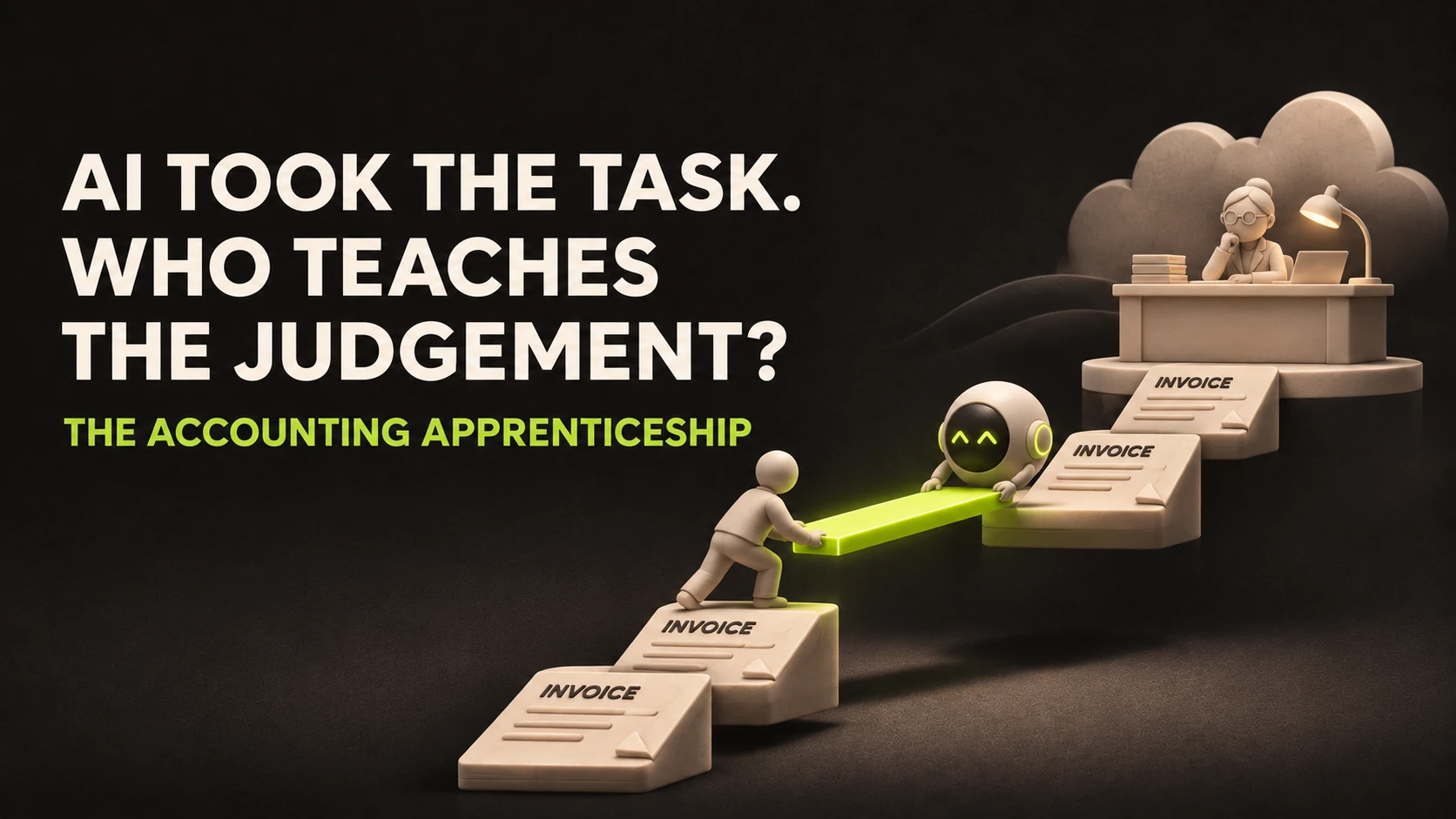
This is already a workforce design problem
In its 1 September 2026 Profession Ready Initiative update, the AICPA described research and engagement involving more than 1,000 members and stakeholders. It identified a broader early-career skill set: accounting fundamentals, business context, research, communication, critical thinking and judgement when using AI. The initiative is a developing framework, not evidence that those skills have already been taught successfully across the profession.
An earlier CIMA survey, published on 17 December 2025, covered 1,446 senior finance and accounting leaders and managers. It found 88% expected AI to be transformative over the following 12–24 months, while 8% felt their organisation was very well prepared. These are respondents’ views from that survey, not a November 2026 census or a junior hiring forecast.

The gap is useful context. My concern is more specific: a firm can adopt a tool quickly while leaving its learning process exactly as it was.
Repetition used to carry several kinds of practice
Consider checking invoices against a ledger. The visible task is comparing fields. The less visible practice includes noticing an unusual supplier name, understanding the timing of an expense and learning which document actually supports an entry.
A beginner may initially miss all three. A reviewer points them out, the beginner tries again and the pattern becomes familiar. Some of that process is inefficient. Some of it is how expertise forms.
If automation removes the first comparison, the remaining practice does not automatically survive inside a dashboard. A queue of “exceptions” can be educational, but only if the junior has enough context to investigate it and somebody reviews the reasoning.
Otherwise the new role becomes clicking Accept on suggestions that look plausible. The firm has replaced repetitive typing with repetitive agreement. That is faster, but it is a poor apprenticeship.
The design goal should be fewer mechanical steps and more deliberate opportunities to explain a decision.
A wrong suggestion can be a useful exercise
A training set does not have to consist only of perfect examples. Carefully selected, permissioned cases can show what happens when a document is incomplete, a period is ambiguous or the obvious explanation is incorrect.
Ask the junior to identify what is known, what is missing and what evidence would change the answer. Then reveal the reviewed outcome and discuss the difference.
For instance, a fictional supplier bill might include a clear amount and date but an unclear description. The exercise is not to guess the most likely tax treatment. It is to write the precise question needed to classify the payment properly.
That question is a professional skill. It can prevent a confident wrong answer more effectively than another round of prompt polishing.
Use synthetic or appropriately anonymised documents for exercises where possible. Where real client material is necessary, the training environment must follow the engagement’s confidentiality and access requirements. A learning programme does not create a new permission to upload records anywhere convenient.
A four-week apprenticeship experiment
Here is a practical programme I would try with a small team. It is a proposed design, not a programme I am claiming to have run or validated.
In week one, select a narrow transaction class and let the junior explain a handful of reviewed examples without AI assistance. What happened in the business? Which records support it? Which date controls the period? Where would they look for authoritative guidance?
In week two, introduce AI suggestions for the same class. Require a short acceptance or rejection note. The junior should identify the evidence used, rather than defend the wording of the model’s answer.
In week three, add incomplete and contradictory cases. Reward a justified request for more information. Do not score every hold as a failure to complete the task.
In week four, ask the junior to review a fresh sample and explain it to someone unfamiliar with the client. Compare the reasoning with the baseline from week one. Have a senior reviewer assess the work against a stable rubric.
The programme should be small enough to repeat. A beautiful training deck that nobody can fit into the working week will not solve the problem.
The review note is the learning artifact
I would keep each note short: proposed treatment, supporting evidence, missing facts and reviewer decision. The objective is a trace of reasoning that a person can inspect.
A transcript of every model response is not an adequate substitute. It can be long without showing whether the junior understood anything. Likewise, a polished paragraph generated by the same assistant being evaluated may hide the precise gap the exercise is supposed to reveal.
Let the junior draft in their own words and discuss the note aloud. Ask what would make them change their mind. Ask which part they checked independently. Ask which source they would trust if two documents disagreed.
These conversations need not become an interrogation. The point is to make uncertainty discussable before it becomes an error in a client deliverable.
Over time, a collection of reviewed notes can reveal recurring difficulties: confusing document dates with service periods, treating a supplier statement as an invoice, or trusting a total without checking its components.
Those patterns tell the manager what to teach next.
Measure learning without turning it into a speed contest
Completion time is useful operational information. It is a weak standalone measure of professional development.
I would look at whether the junior finds missing evidence, distinguishes a draft from a confirmed record, explains why an exception matters and asks an actionable question. I would also track recurring reviewer corrections across comparable cases.
Use the same difficulty level when comparing results. A junior who receives harder cases in week four may take longer while demonstrating much better judgement. A simple speed chart could label that progress a regression.
Measure the burden on reviewers too. If the new process saves junior hours but requires a senior to rewrite every conclusion, the team needs to understand that trade-off.
The desired result is a growing ability to handle unfamiliar work with appropriate supervision. It is not a rising percentage of suggestions accepted without discussion.
Any claimed improvement should name the sample and method. A small internal exercise should not become a sweeping claim that AI has solved the profession’s talent shortage.
Give managers time to teach
Training often fails at the calendar. A firm announces a new approach, then gives the manager the same deadline, client load and utilisation target.
If coaching is important, reserve time for it. Decide which engagements can support supervised learning and which situations require an experienced person to take over immediately. Make the boundary explicit so that a junior does not feel pressured to improvise on a high-consequence decision.
The investment should also survive a busy period. A shorter, regular review conversation may be more durable than a large workshop that gets cancelled whenever work accumulates.
For an owner evaluating AI productivity, this is a real cost of maintaining the future firm. It belongs beside software subscriptions and implementation work. Removing it from the calculation can make near-term savings look more attractive than they are.
That is one reason the PE-versus-AI accounting debate needs a training line in its economics, not just a headcount line.
What I want the software to teach by default
I’m building Arova, and the part of its approach I particularly like here is making bill decisions inspectable and keeping approval with a person. A useful suggestion gives a reviewer something concrete to challenge.
For a junior, seeing a proposed classification alongside the source and the missing facts is a better starting point than receiving a finished answer with no explanation. It creates room for the reviewer to ask, “What supports this?”
That does not make Arova a substitute for professional training, and I am not claiming learning outcomes we have not measured. It makes the product’s design compatible with a more deliberate apprenticeship. As its builder, I think that is a worthwhile standard for accounting AI.
The same principle applies to Ask Arova’s source-backed answers: a useful answer should help someone inspect the underlying work, rather than make asking a follow-up feel unnecessary.
The partner pipeline is a design choice
The profession does not face a choice between making juniors suffer through avoidable drudgery and abandoning the development of expertise. It can redesign the practice around the capabilities that matter.
That requires being precise about the learning objective inside each task. Some steps can disappear entirely. Others need to become a simulation, a supervised review or a short explanation attached to real work.
A good manager should be able to say what the junior is learning this month and how the team will recognise progress. A good tool should make that work easier to observe.
If AI removes the afternoon spent hunting a difference, use some of the recovered time to teach why the difference mattered. The profession will still need people who can answer that question when the next unfamiliar transaction arrives.