The 45-Day MSME Rule Can Turn a Payables Delay Into a Tax Problem.
Share article
An unpaid supplier bill can look harmless in a payables report. It is already booked, the expense has reached the profit and loss account, and someone plans to clear it in the next payment run. For a qualifying micro or small supplier, that delay can also change when the buyer gets an income-tax deduction.
That is why the MSME payment rule deserves attention before the March closing checklist. The useful question in November 2026 is not simply whether an invoice is outstanding. It is whether the supplier is covered, which payment deadline applies, what evidence starts the clock, and whether payment has actually happened.
This is a practical review of the 15-day and 45-day problem, the move from section 43B(h) to section 37(2)(g), and the kind of accounting workflow that helps a small issue stay small.
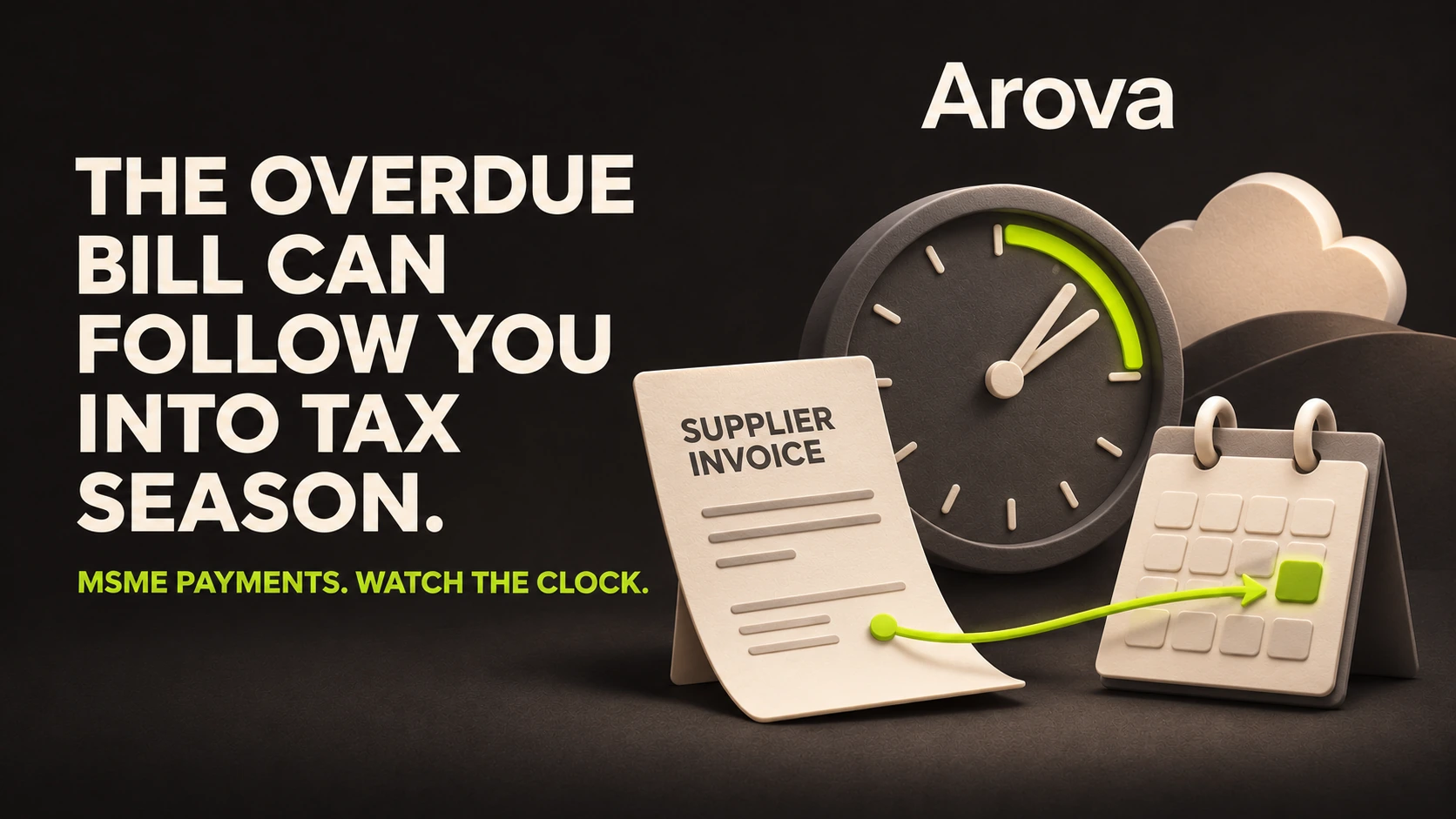
Forty-five days is the ceiling, not the default
For a covered micro or small supplier, the agreed payment period must be in writing and cannot exceed 45 days from acceptance or deemed acceptance. Without that written agreement, the relevant period is 15 days. The Ministry of MSME sets out these distinctions in its official delayed-payment guidelines, section 11.1.1.
The guidance includes the important limit:
“in no case, beyond forty-five (45) days”
Calling this only the “MSME 45-day rule” makes it easy to miss the earlier deadline. A supplier with no relevant written agreement should not quietly inherit 45 days because that is the number everyone remembers. Equally, a valid shorter written period is not automatically extended to the maximum.
The practical task is to connect the supplier record to the actual agreed terms. An empty terms field is a fact to resolve, rather than an invitation to choose the most convenient date.
The tax issue is timing, and timing can hurt
For the tax year beginning April 2026, the relevant provision is section 37(2)(g) of the Income-tax Act, 2025. Earlier periods retain the older Act's section 43B(h) reference. The enacted Act, pages 63–64, puts the covered overdue amount on an actual-payment basis. Section 37(3)'s concession for paying certain other liabilities by the income-tax return filing deadline excludes this clause.
That does not mean every late bill creates a permanent lost deduction. A qualifying expense paid late but within the same tax year can still satisfy the actual-payment requirement for that year. A covered overdue amount remaining unpaid at year-end can instead move the deduction to the year of actual payment, subject to the other conditions for deduction.
That distinction matters when someone says “pay it before filing the return.” The return deadline is not a general extension of the MSME payment window. A year-end review needs the actual payment evidence and the applicable statutory deadline, not just a promise that the cash will leave eventually.
Start with supplier evidence, not a spreadsheet colour
The letters MSME cover micro, small and medium enterprises. This specific payment-linked tax provision concerns micro and small enterprises. A generic “MSME: yes” flag is too blunt for the decision.
A sensible supplier file records the classification, Udyam details where relevant, when the evidence was obtained and who reviewed it. It also keeps the written payment agreement accessible. Questions about coverage, registration history or a disputed supply should reach the accountant with those documents attached.
Think about a supplier master used by three funds. If one team has obtained a declaration but another team has not seen it, the same business can be treated differently across books. The answer is a shared evidence process with entity-specific transactions, rather than a confident label copied into every file without context.
This is also a good place to stop an AI system from guessing. A missing supplier fact should create a request for evidence and an owner for that request. It should not become a fabricated classification that happens to make the dashboard look complete.
The invoice date and the legal clock need separate attention
The statutory reference is acceptance or deemed acceptance, not a universal rule that every clock begins on the date printed on an invoice. Delivery records, service acceptance and documented objections can matter. The Ministry's guidelines use those acceptance terms for a reason.
In an operational system, an early warning based on the bill date can still be helpful. It gives the team something conservative to review while the supporting evidence is collected. The warning becomes misleading if the software presents that convenience as a final legal conclusion.
For example, imagine an invoice uploaded on a Tuesday after a service was completed earlier. The upload timestamp records when the system saw the document. It does not, by itself, establish when the buyer accepted the service. Those are different events, and preserving both makes the review easier.

The chart shows three deadline scenarios: no written agreement, an assumed 30-day written agreement, and the 45-day statutory maximum. It is not a grace-period menu. The appropriate scenario and start date have to come from the transaction's evidence.
A November payment queue is more useful than a March surprise
Once the facts are known, the accounting task becomes fairly concrete. Show bills approaching their review deadline, bills already past it, bills awaiting approval and bills whose payment evidence is missing. Put an accountable person beside each unresolved step.
The most urgent item may be a small invoice waiting for one internal approval. A large payable with several weeks remaining may need less immediate attention. Sorting only by invoice value or age can hide that difference.
It helps to work backwards from the next payment run. A bill cannot be paid on Friday if nobody has resolved its disputed amount, checked the bank details or obtained approval by Thursday. A useful alert gives enough time for those steps. An alert that first appears after the deadline mostly documents the failure.
Nothing about that requires automatic payment. The person authorising money still needs the bill, the supporting records and the right entity. Better preparation makes that person's decision easier to make on time.
What I like about Arova's approach to this problem
I’m building Arova, so this is a builder's view of the product. The part I value here is that MSME attention sits beside the bill and its payment workflow. It is not left as a detached reminder that somebody must later reconcile with the books.
The current app records supplier category and agreed days, shows bills as open, due soon, overdue or paid, and brings potential year-end exposure into view. It can also prepare a payment-run document for review. That is a useful extension of AI invoice processing: the extracted bill leads to a practical next action.
There are two important details in the current implementation. Its early review clock uses the bill date; the statutory acceptance or deemed-acceptance date still needs appropriate review. A bill is treated as paid when its bank line has been matched in Banking. That makes the payment evidence visible, but an unmatched transfer still needs investigation rather than being assumed unpaid in the real world.
I prefer that concrete account of the workflow to a claim that AI “solves MSME compliance.” Arova helps avoid missed deadlines by surfacing the work. The quality of the result still depends on supplier evidence, timely approval and accurate bank reconciliation.
Exposure is not the same number as tax payable
A dashboard showing a bill amount at risk is a starting point for review. It is not automatically the amount of deduction to disallow, and it is certainly not the additional income tax payable.
The current Arova view uses the bill's gross amount as a review exposure. An accountant still needs to determine the relevant expense amount, tax treatment, payments and adjustments. Creditable GST, partial settlements and other transaction details can make a one-number interpretation misleading.
Keep three questions separate in the closing file: which bills need review, what deduction timing adjustment follows, and what effect that adjustment has on the actual tax computation. The first can help organise the second. Neither substitutes for the third.
This also prevents exaggerated sales arithmetic. A ₹1 lakh overdue invoice does not prove that software has saved ₹1 lakh in tax. A product earns trust when its descriptions preserve the difference between invoice value, deductible expense and tax cash flow.
Build a closing file while the evidence is still easy to find
A practical monthly review can retain the supplier classification evidence, applicable written terms, acceptance records where needed, the bill, approvals and bank match. Any judgement or unresolved question should travel with that record.
For items crossing year-end, keep a clear trail into the later payment period. A deferred deduction needs follow-through; a note saying “disallowed last year” is not enough if nobody later checks whether payment has made it eligible for consideration.
For a multi-entity team, preserve which entity owes the supplier and which bank account settled it. A group-level queue can organise attention, but it should not blur the individual books. That is one reason I keep coming back to separate books with a shared work view.
The attraction of accounting automation is often described as fewer keystrokes. On this problem, the better outcome is earlier attention: evidence collected while the supplier remembers the transaction, approvals obtained while there is still time, and a payment that can be traced without rebuilding the story months later.
Two questions worth asking at the next finance meeting
Ask which covered supplier bills could miss their deadline before the next payment run. Then ask which supposedly settled bills still lack a bank match. Those questions expose different operational gaps, and each has a person who can close it.
The same habit helps with missing GST credit and supplier follow-up: identify the evidence gap, assign the next step and verify what changed. Arova's useful promise is help with that daily discipline. It helps the team notice a consequential bill while there is still something practical to do about it.