The Most Interesting Open Model Right Now Has No Official Benchmarks
Z.ai dropped a 744-billion-parameter model on June 13, 2026, and published zero benchmark numbers. No SWE-bench Verified. No LiveCodeBench. No HumanEval. In an industry where model releases come bundled with 47-slide benchmark decks, radar charts comparing every competitor, and carefully chosen held-out eval results, that absence is the most interesting thing about GLM-5.2.
This post is about what that decision signals, what the architecture actually means, and whether any of it matters for teams shipping real products.
What GLM-5.2 actually is
GLM-5.2 is a Mixture-of-Experts model. Total parameters: 744B. Active parameters per token: ~40B. Number of experts: 384. Context window: 1 million tokens. Max output: 131,072 tokens per response. Training data: 28.5 trillion pretrain tokens. License: MIT.
The MoE architecture is the part that matters most for understanding what you're running. When a token passes through the model, a learned gating router picks a handful of those 384 experts to activate for that specific token. The result is a model that costs roughly the same as a 40B dense model per forward pass — but has the representational capacity of a 744B model across the full expert pool. That's the deal: you pay for 40B, you get 744B.
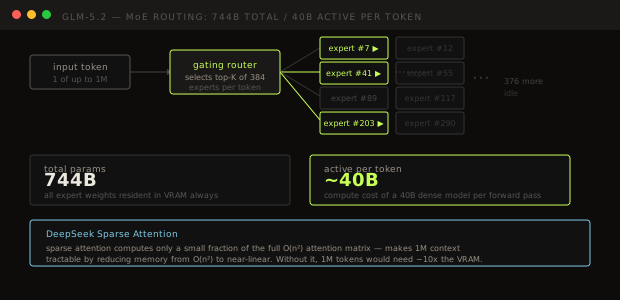
The 1M context window runs on DeepSeek Sparse Attention — a technique that reduces the O(n²) memory complexity of standard attention to near-linear. Without it, loading 1M tokens into attention would require roughly 10x the VRAM. With it, it's expensive but tractable on the right hardware.
The architecture is a direct evolution of GLM-5 (February 2026) and GLM-5.1 (April 2026). The primary change in 5.2 is the context jump: from ~200K tokens in 5.1 to 1M in 5.2. Z.ai calls the 1M model glm-5.2[1m] in their API to distinguish it from a standard-context variant.
One number that got quietly updated: LLM Reference lists GLM-5.2 at 753B total parameters, not 744B. The discrepancy likely reflects different counting conventions — whether embedding tables and shared expert layers are included in the total. At this scale, the exact figure is less important than the ballpark: this is a frontier-scale MoE, not a distilled or mid-tier model.
The benchmark silence
Let's be direct: not publishing benchmarks is a choice, not an oversight.
Z.ai's announcement "focused on availability, context, and the open-source roadmap." Their only public statement: "Intelligence should be open, accessible, and ready to build with." No scorecard. No comparison table.
There are two plausible readings.
Reading one: confidence. GLM-5.1 had already set a credible baseline. On SWE-Bench Pro, 5.1 scored 58.4, edging out both GPT-5.4 (57.7) and Claude Opus 4.6 (57.3). On Z.ai's own coding evaluation using Claude Code as the test harness, 5.1 scored 45.3 — within 2.6 points of Opus 4.6's 47.9 (self-reported by Z.ai, not independently verified). The lineage is strong. Maybe Z.ai decided the 5.1 numbers speak for themselves, and 5.2 ships when it's ready rather than when the eval deck is ready. (For what it's worth, LLM Reference does show some GLM-5.2 numbers post-launch: 62.1% on SWE-bench Pro, 82.7% on Terminal-Bench 2.1, 99.2% on AIME 2026 — but these weren't in the official announcement.)
Reading two: avoidance. Benchmark contamination is a real problem. Static benchmarks like HumanEval and MBPP have been recycled so many times that high scores have become almost meaningless — documented cases of Llama and Phi variants scoring 10-13 percentage points above what they'd score on rephrased versions of the same problems. The few benchmarks that actually resist contamination — SWE-Bench Verified, LiveCodeBench, Humanity's Last Exam — require careful run setups, and the results are hard to control narratively. If 5.2's big feature is the 1M context and the open weights rather than raw bench numbers, why hand critics a table to fight over?
Both readings are probably partially correct. The more interesting point is what the absence reveals about where Zhipu thinks the competition actually is. They're not fighting OpenAI on o3-style math evals. They're competing on who can get into the developer ecosystem fastest — and for that, the open weights and the MIT license matter more than any benchmark deck.
What 1M context actually changes
The honest answer: it changes specific things dramatically and most things not at all.

Where it's genuinely useful:
Whole-repo coding tasks. A typical monorepo clocks in at 50K–300K tokens. Loading the entire thing into context means the model sees all dependencies, interfaces, and conventions simultaneously — no chunking, no retrieval misses, no stale embeddings. This is the use case GLM-5.2 was clearly built for. Z.ai positions the model specifically for "long-horizon coding, repo-scale agentic refactors, and multi-file plan-then-execute traces."
Long document analysis. A single legal contract, technical specification, or audit report that fits in context but benefits from cross-reference reasoning. The model can see clause A on page 3 and clause B on page 87 simultaneously without any retrieval layer.
Extended agentic traces. Multi-step agent workflows where the model needs full execution history to make correct decisions. At 200K context, long traces get truncated; at 1M, there's room to breathe.
Where it doesn't replace what you already have:
Live or unbounded corpora. If your knowledge base is 10M tokens and growing, no context window solves that. RAG is still the right layer.
Low-latency production APIs. Filling a 1M-token context means a large prefill cost before the first token is generated. Time-to-first-token scales with context length. RAG that retrieves 3-5 relevant chunks keeps TTFT under a second; 1M-token prefill does not.
Frequently updated data. Context windows are static snapshots. RAG fetches fresh chunks on every call. If your knowledge changes daily, long context doesn't help.
Cost. At OpenRouter pricing, GLM-5.2 runs $1.40/million input tokens and $4.40/million output tokens. A single 1M-token call costs $1.40 in input alone — before you've generated a word. That's fine for occasional deep-analysis tasks; it's not a pattern you want firing for every user query.
There's also the "lost in the middle" problem. Research consistently shows that retrieval from very long contexts degrades for information at the middle of the window. The model is better at the start and end. At 1M tokens, the middle is a long way from either edge.
Most production stacks will end up running both: long context for deep reasoning over bounded corpora, RAG for retrieval from large or live sources. They solve different problems.
The MIT license matters more than the benchmarks
This is the actual story.
MIT means: fork it, fine-tune it, quantize it, embed it in your product, run it in an air-gapped environment, distil it into a smaller model, sell it commercially. No usage caps, no attribution requirements beyond keeping the license notice, no "don't use outputs to train competing models" clause like Llama 4's.
DeepSeek-V3 also ships MIT. So does Mistral's small tier. Mistral Large 3 rounds out the open-weight frontier from Europe — Apache-licensed, with a European provenance that matters for data residency. But at 744B parameters with 40B active and 1M context, GLM-5.2 is the largest model at this capability tier under a genuinely permissive license as of June 2026.
That opens things that weren't open before:
| WHAT MIT UNLOCKS | IMPLICATION |
|---|---|
| Fine-tuning on proprietary data | Adapt the model to your domain without legal uncertainty. No derivative restrictions. |
| Distillation into smaller models | Use GLM-5.2 as the teacher to build a domain-specific 7B or 13B model you can actually serve cheaply. |
| Air-gapped deployments | Finance, defence, healthcare, and government workloads that can't send data to an external API. |
| Embedding in commercial products | No per-seat licensing negotiation. Ship it, sell it, move on. |
| Quantized variants | INT4 quantization drops weight memory to ~372GB — reachable with 4× H100 80GB. Still a big server, but a different class of cost. |
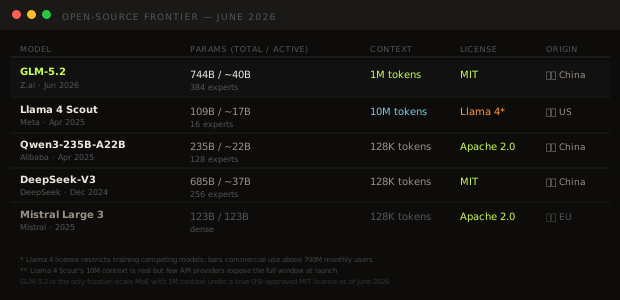
Compare to Llama 4: same "open weights" marketing, but the license bars using model outputs to train competing models and caps commercial use at 700M monthly active users. Those clauses matter at scale. MIT has neither.
Hardware reality check
Self-hosting GLM-5.2 is not a weekend project.
The full FP8 checkpoint needs approximately 744GB of VRAM just for weights. The 8× H200 SXM configuration (1,128GB aggregate HBM) is the practical sweet spot — it covers the weights and leaves headroom for KV cache. At 1M context, KV cache scales to roughly 100GB per concurrent request in FP8. Running two simultaneous 1M-context requests on 8× H200 puts you at the edge.
For BF16 precision: you need 16× H100 80GB or equivalent — ~1,488GB just for weights. Most teams won't go there.
INT4 quantization (Q4_K_M GGUF) cuts weights to ~372GB. That fits in 4× H100 80GB or 2× H200 141GB. Quality degrades meaningfully at Q4, but it's the path for teams that need to own hardware. There's even a Q2 GGUF path that runs on a Mac Studio M3 Ultra with ≥256GB unified memory — genuinely useful for prototyping.
Cloud cost for 8× H200 24/7 runs $21K–36K/month reserved. Z.ai's hosted Max plan is ~$80/month. The math is not close unless you're running at high sustained throughput — and even then the Z.ai API wins unless you have specific compliance, data residency, or latency requirements that demand on-prem.
The self-hosting case is real for: regulated industries that can't send data off-premises, teams building a distillation pipeline who need repeated high-volume inference, and orgs that want to fine-tune and serve a custom variant. For everyone else, the API is the right answer.
The geopolitical layer
It would be dishonest to write about this release without acknowledging the context it landed in.
GLM-5.2 launched on June 13, 2026, within days of Anthropic suspending access to its Fable-5 and Mythos-5 models following "an export control directive from the US government based on national security concerns." Zhipu AI's Hong Kong-listed stock surged 32.8% the same day.
This isn't coincidence. The US Commerce Department placed Zhipu on its Entity List in January 2025, citing AI advancement for Chinese military modernization. Zhipu is constrained from accessing Nvidia's newest chips — GLM-5 was reportedly trained on Huawei hardware. And yet the model is here, it's competitive, and it's MIT licensed.
Open weights under US-friendly licensing is a move. A Chinese lab releasing a frontier model that any team in the world can download, run, fine-tune, and distribute — that's an access equalizer in a world where Western proprietary models are becoming geographically restricted. For teams in Southeast Asia, South Asia, Latin America, and Africa that are watching Anthropic's export control directives nervously, GLM-5.2 is the model they can build on without worrying about whether the API keeps working.
Zhipu frames it as "intelligence should be open, accessible, and ready to build with." That framing isn't neutral — it's positioning against exactly the walled-garden dynamic that export controls are tightening. The MIT license isn't just developer-friendly. It's a geopolitical move.
The US-China chip export war has had an unintended effect: it's pushed Chinese labs to build more efficient architectures (you can't be wasteful when you're GPU-constrained), and it's pushed them toward open-source distribution (the software can cross borders that hardware cannot). GLM-5.2 is a product of both pressures.
What teams should actually do with this
If you're on a coding-heavy workflow: Try the API now. The Z.ai GLM Coding Plan is cheap — roughly a tenth of Anthropic's premium pricing at launch. GLM-5.1's SWE-bench numbers were legitimate. Treat 5.2 as "at least as good as 5.1 until independent evals land" and benchmark it against your actual tasks, not someone else's leaderboard.
If you're thinking about self-hosting: The MIT license makes it legal to do whatever you want with the weights. The hardware requirements make it impractical for most teams. Start with the API; move to self-hosting only if you hit compliance requirements, fine-tuning needs, or volume economics that justify a GPU cluster.
If you're building a distillation pipeline: This is the most interesting use case under MIT. Use GLM-5.2 as the teacher model to generate training data for a domain-specific 7B or 13B model. You get frontier-scale reasoning in the training signal; you serve something cheap and fast.
If you're running RAG infrastructure: Don't throw it out. 1M context is a complement, not a replacement. The right mental model is: RAG for retrieval from large/live/unbounded sources, long context for reasoning over bounded corpora you've already retrieved. They work together.
On the benchmarks: Wait for independent third-party evals before making architecture decisions based on GLM-5.2's numbers. LLM Reference shows a 62.1% SWE-bench Pro score, but those weren't in the official launch announcement and haven't been independently verified. GLM-5.1's 58.4 on the same benchmark is the credible floor. Anything above that is upside until it's confirmed.
The benchmark silence is still the most interesting thing about GLM-5.2. But what it points toward — MIT license, 1M context, 744B MoE, from a lab that's been systematically closing the gap with Western frontier models — is more interesting than any score they could have published.