ExtendDB Keeps the API Familiar. The Operating Contract Still Changes.
Share article
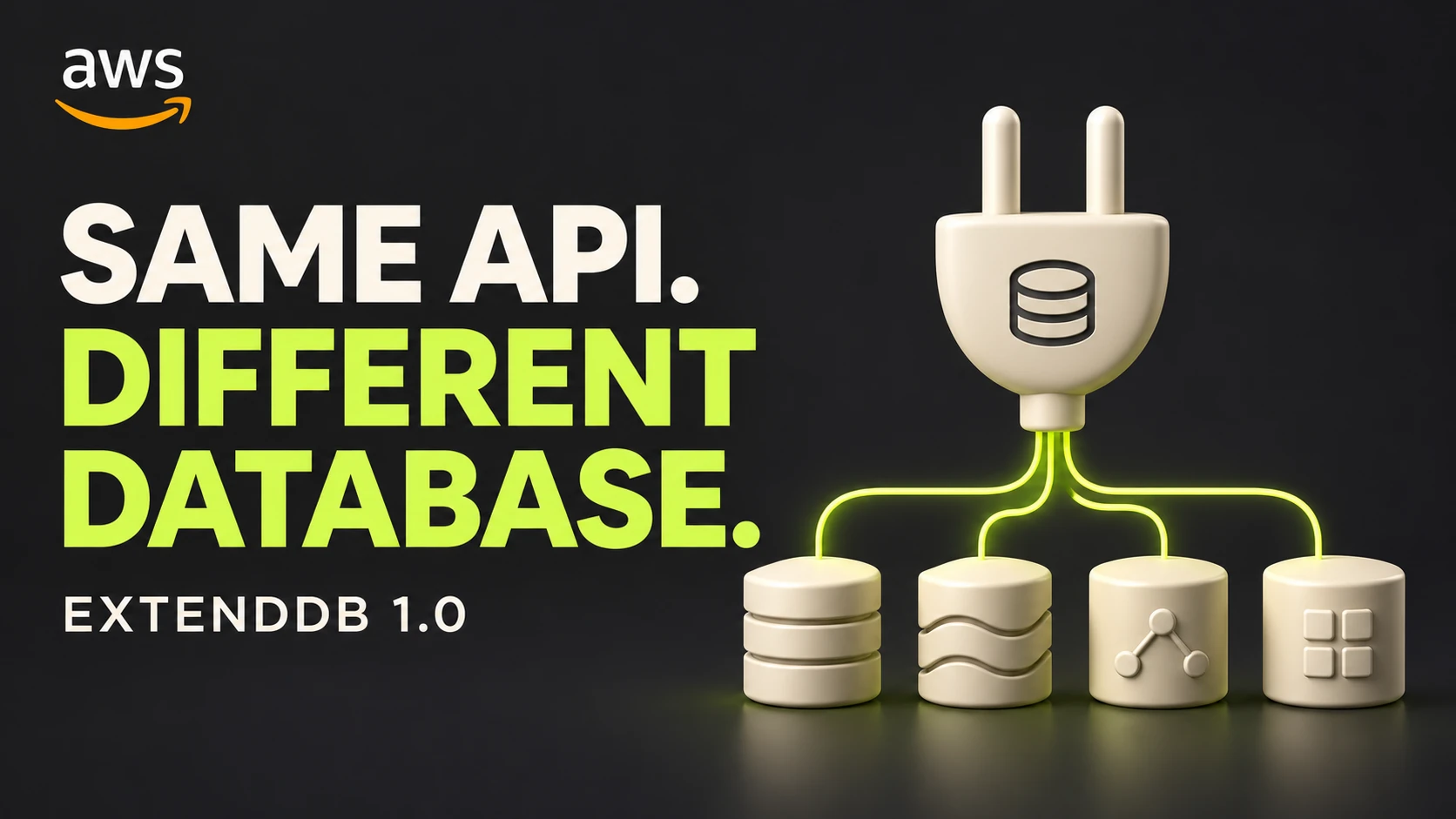
Changing a database endpoint is a small edit with a potentially large operational meaning. The application may continue speaking the same API while the team inherits a different set of responsibilities for recovery, capacity and failure diagnosis.
AWS announced ExtendDB 1.0 on November 18, 2026, describing it as a production-use release of its open-source DynamoDB-compatible adapter. The announcement lists PostgreSQL, SQLite, Cassandra and MongoDB storage backends, plus a local development option using SQLite. AWS claims full DynamoDB API compatibility; this article has not independently tested that claim. AWS’s ExtendDB 1.0 announcement
The interesting question is therefore not simply whether an SDK call can be reused. It is what contract the application actually depends on beyond the shape of that call. A migration deserves a written account of those dependencies before compatibility becomes a purchasing conclusion.
Separate the interface from the service
An API describes how an application asks for work and receives responses. An operating environment also determines how the system behaves under load, how failures are handled, how data is restored and who is responsible when something stops. These concerns are related, but one does not fully specify the others.
A familiar interface can reduce the amount of application code that needs to change. That is valuable. It does not establish that two deployments have identical latency, throughput, availability or support arrangements. Those conclusions require evidence about the actual configuration and workload under consideration.
Write two lists in the migration proposal. The first contains the API operations the application uses. The second contains the operational properties it needs. Keep them separate during testing and bring them together for the final decision. Otherwise a successful happy-path integration test can acquire a much broader meaning than it deserves, and the team may discover the missing requirements only after production traffic arrives.
Inventory behaviour the application quietly assumes
Start with the paths that matter to users: creating a record, changing it, retrieving it and resolving concurrent updates. Then identify assumptions embedded in error handling, pagination, retries and conditional operations. Code often depends on more than the operation names that appear in a dependency list.
A fictional order system might use a conditional write to prevent a state transition after cancellation. The migration test should verify the business invariant under the relevant race, not merely that a normal write succeeds. Another service might rely on a particular pagination pattern to process a complete set. Its test needs to establish completeness without accidental repetition under the intended workflow.
Do not turn this inventory into an accusation that an adapter is incompatible. It is a way to define what compatibility means for your application. A concise list of actual dependencies is more informative than an enormous generic checklist. It also exposes unnecessary assumptions that could be removed regardless of whether the database migration goes ahead.
Choose the backend for the workload you have
A choice of backends is a choice that needs an owner. Local development may prioritise simple setup and quick disposal. Production may prioritise operational familiarity, recoverability and the team’s existing infrastructure. Different environments can reasonably choose differently, provided the differences are understood and tested.
Ask what your team already knows how to operate. A backend that looks attractive in isolation may add an unfamiliar recovery process or a new monitoring burden. Conversely, using an existing platform may simplify operations, but only if the proposed workload fits within its capacity and ownership model. Familiarity is useful evidence, not an automatic approval.
Record the reasons for each environment’s choice. If development uses a different backend from production, define the tests that run against the production-like configuration before release. A convenient local setup should shorten feedback without becoming the only place important behaviour is checked. The earlier article on GraphQL’s compatibility chain examines a similar principle: a shared interface still has to work through the components you actually run.
Test recovery as part of compatibility
A database migration is not complete when the application can write new data. It also needs a credible answer to how data will be recovered after an operational mistake or infrastructure failure. That answer should be demonstrated in the intended environment, with a representative dataset and an explicit acceptance condition.
Define what a successful restore means. The process should recover the required records, preserve the relevant relationships and leave the application able to resume safely. Record how the team identifies the restore point and reconciles work that occurred around it. Do not assume that restarting the application proves the restored data is complete.
This is not a claim about a specific ExtendDB limitation. It is a responsibility created by choosing and operating a deployment. The team should understand which layer performs backups, which layer restores them and who checks the result. A practical exercise often reveals missing access, undocumented steps or unclear ownership before those gaps become part of an incident.
Make the verification pack finite and meaningful
Consider an illustrative pack of 30 checks: 12 business-invariant checks, eight concurrency and retry checks, six recovery checks and four deployment checks. These numbers describe a fictional planning allocation, not a benchmark or a recommended universal minimum. Their purpose is to show that successful API calls are only one part of the acceptance work.

Each check should connect to a reason the application exists. For example, a business-invariant check could establish that a cancelled order cannot be shipped through an outdated worker. A recovery check could establish that a restored dataset supports the reconciliation process. A deployment check could confirm that the intended configuration is actually running.
Avoid writing dozens of tests that merely repeat an SDK wrapper’s implementation. Concentrate on consequences that would matter if they failed. Keep a short record of the environment, dataset and software versions used, so a passing result remains interpretable when someone later changes the backend or upgrades the adapter.
Price the responsibilities that move with the data
A cost comparison should name what is included on both sides. Infrastructure charges, storage, backup, operational labour and incident coverage can sit in different places depending on the deployment. Comparing only the most visible line item can turn a transfer of responsibility into an imaginary saving.
Use a workload description with volumes, access patterns and the operating period. Separate measured usage from assumptions. If you do not yet know how much operational attention the new arrangement requires, label that uncertainty and investigate it during the trial. Do not fill the gap with zero because nobody has submitted a timesheet yet.
A migration may still be attractive for reasons beyond immediate cost, such as deployment flexibility or alignment with an existing platform. State those reasons directly. They deserve evaluation on their own terms. A decision becomes easier to review when its authors are explicit about whether they are buying flexibility, reducing expenditure, simplifying development or meeting a particular operational requirement.
Design the cutover around evidence
Moving production traffic requires a plan for knowing where authoritative data lives at each stage. Define the cutover boundary, the handling of in-flight work and the evidence needed before continuing. If a rollback is proposed, explain how it handles changes made after the new system begins accepting writes.
A plan that says only “switch the endpoint back” is incomplete when the two destinations can diverge. The team needs a method for reconciling that divergence or a carefully bounded period in which the relevant writes are controlled. The appropriate design depends on the application; the requirement is to make the issue explicit before the migration window.
I’m building Arova, where the connection between a source document and the resulting accounting workflow makes data continuity an especially concrete concern. That is why I would judge a storage change by preserved meaning and recoverability, not just successful connection setup. This is not a claim that Arova uses ExtendDB. The discussion of rehearsing a software exit provides a related method for checking what remains usable after data moves.
Assign an owner to the new operating contract
Before approval, ask one person to explain the entire path from application request to durable data and eventual recovery. They do not need to perform every task personally. They do need to know which teams own the layers and how an incident moves between them. Shared responsibility works better when the boundaries are written down.
Give the final decision a narrow, testable form. For example: this workload, on this backend and configuration, has passed these acceptance checks, with these unresolved constraints. That statement is more useful than a universal claim that two systems are interchangeable. It also creates a manageable starting point for future changes.
ExtendDB 1.0 is timely because it makes a familiar API available through a broader deployment proposition. The engineering opportunity is real enough to investigate without inventing a performance result or assuming a cost advantage. Treat interface compatibility as the beginning of the evaluation. The decision to operate the workload belongs to the complete contract: behaviour, recovery, ownership and the evidence that those pieces work together.