Annual Cash Arrived. The Service Obligation Has Not Gone Away.
Share article
The bank balance rises on Monday. The service obligation lasts until next November. For a young software business, that gap can feel like freedom precisely when it deserves careful planning.
Annual prepayment can improve the timing of cash receipts. It does not make the remaining months of delivery disappear. A founder deciding how much to hire or spend needs a view of the commitments attached to the money, not only the amount that arrived.
This is an original practical planning piece, not a report of a new funding event. The accounting reference is also narrower than the operating argument: for entities applying IFRS 15, revenue recognition reflects the transfer of promised goods or services and satisfaction of performance obligations, rather than simply cash receipt. Specific treatment depends on the contract and applicable framework. IFRS Foundation's IFRS 15 overview
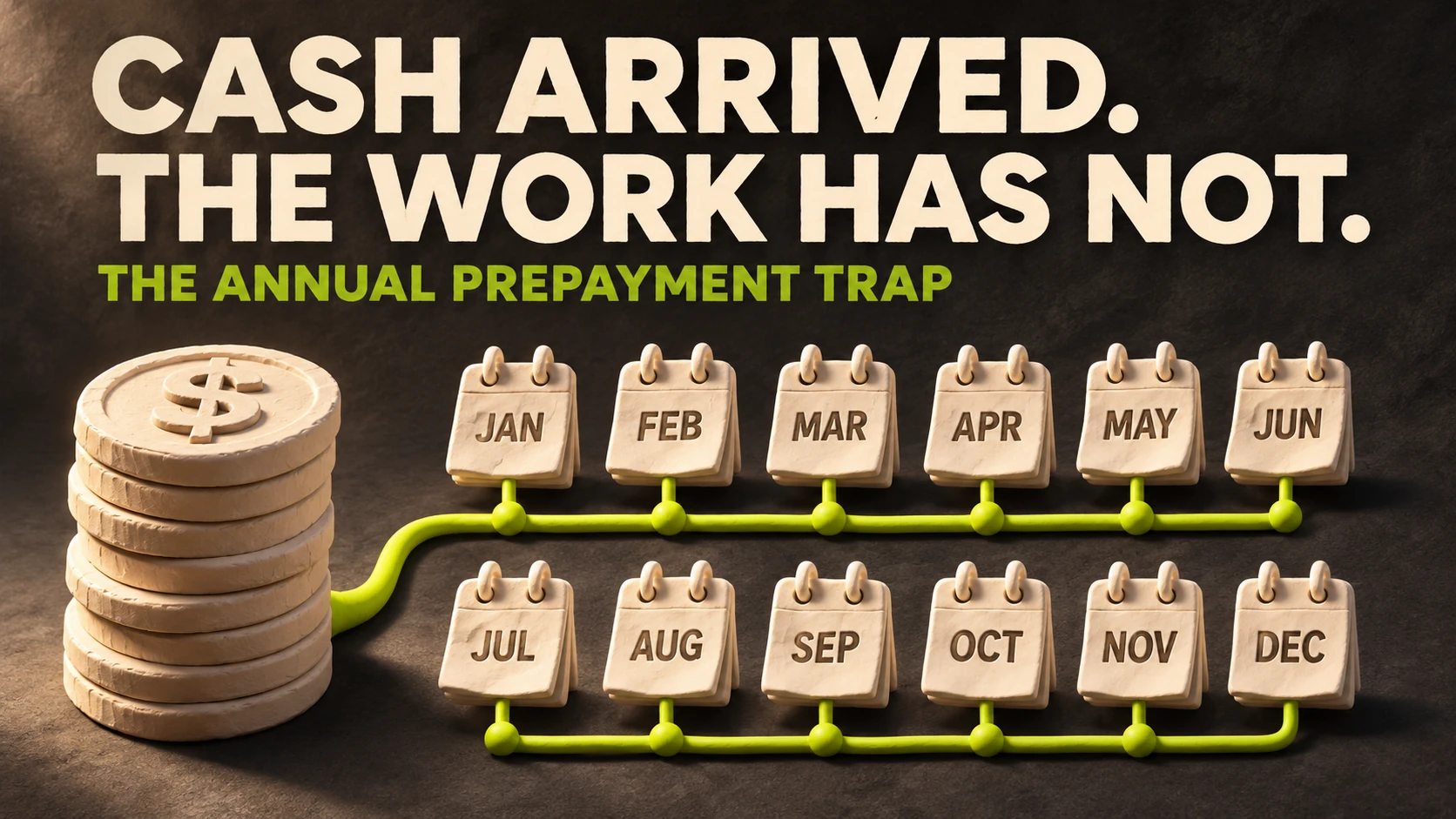
Put a delivery calendar beside the bank receipt
Imagine a fictional software startup that receives £120,000 upfront for twelve months of service. The founder's first spreadsheet records the cash and extends the apparent runway. A second spreadsheet should ask what the company must continue providing over those twelve months.
List the service period, promised scope, onboarding work, support commitments and any review points. Then identify which costs depend on usage and which continue even if the customer is quiet. A fixed platform commitment, a scheduled support duty and a burst of onboarding work have different timing.
Do not infer the delivery pattern from the invoice schedule alone. The invoice may be annual for commercial convenience while the workload is concentrated early or varies with the customer's activity. A simple monthly model should explain those assumptions rather than spread every cost evenly by default.
The output is a delivery calendar connected to the receipt. It does not need to be an accounting journal or a legal interpretation. It is a management view of the work the business has promised and the resources it expects to need while fulfilling that promise.
Keep cash, revenue and contribution as different views
Cash tells you what is available in the bank, subject to other commitments and restrictions. Revenue is an accounting measure whose treatment depends on the relevant framework and contract. Contribution is a management calculation that depends on which costs you choose to include. Using the words interchangeably can make a healthy receipt look like a fully earned surplus.
For the fictional startup, keep three separate schedules rather than forcing one chart to answer every question. The cash schedule records receipts and payments. The accounting schedule follows the reviewed treatment. The delivery-cost schedule estimates the resources still needed to serve the contract.
Do not use this article's simple example as an automatic rule to recognise one twelfth of any annual contract each month. Real arrangements can contain different obligations, variable amounts or other features that need assessment. The illustrative operating model deliberately avoids deciding those accounting questions.
This separation is useful even before a startup has sophisticated finance systems. A founder can say, “We have received the cash, but this much planned work remains,” without pretending that the statement resolves revenue recognition or establishes a distributable profit.
Model the remaining service cost explicitly
Suppose the fictional £120,000 contract requires £12,000 of onboarding cost and £3,000 per month of ongoing direct service cost. Across twelve months, the planned direct cost is £48,000. These invented assumptions exclude overhead, taxes, financing, refunds and unexpected work.
The arithmetic leaves £72,000 before those excluded items. It does not establish profit or an amount the founder can safely withdraw. The point is to make the remaining obligation visible rather than treating all cash not yet spent as spare capacity.

The chart shows remaining planned direct service cost immediately after receipt, after onboarding and after six service months: £48,000, £36,000 and £18,000. The scenarios assume onboarding is completed before recurring service cost is incurred. This is a fictional planning schedule, not a customer result, reserve requirement or accounting liability calculation.
As actual work occurs, compare it with the assumptions. If onboarding requires more effort than expected, record why. If usage changes the recurring cost, update the remaining schedule. The useful result is not a static margin percentage; it is a current view of what fulfilling the promise is likely to require.
Make the annual discount buy something specific
An annual discount trades price for a commercial benefit. That benefit might be earlier cash, a longer commitment or simpler collection administration. The startup should be able to say what it receives in exchange rather than copy a discount from a competitor's pricing page.
Compare the annual offer with a clearly defined alternative. If monthly customers can cancel at any time, the comparison includes a commitment difference. If both options bind the customer for a year, the main difference may be payment timing. Those are not the same deal economics.
Use a scenario rather than an invented market benchmark. Ask how much contribution the discount removes, what collection uncertainty it reduces under the assumed terms and how long the business expects to serve the customer. Keep the assumptions explicit and avoid claiming that annual billing automatically improves retention.
The earlier discussion of keeping old SaaS prices concerns the cost of a continuing price promise. Annual prepayment creates a different question: what delivery commitment accompanies cash received now? Both deserve a model before the promise becomes difficult to change.
Stress the cost and the commitment separately
A useful stress test changes one important assumption at a time. What if the customer's usage doubles? What if onboarding takes longer? What if an external provider raises its price? What if the team needs an additional support capability to meet the promised service level?
Do not combine every pessimistic assumption into an unexplained disaster number. Show which change creates which cost. That helps the founder identify an action: clarify scope, add a usage boundary, improve onboarding or avoid a commitment the team cannot economically support.
Also inspect the contract's actual cancellation and refund terms with the appropriate adviser. This article does not assert a universal right to a refund or a universal ability to keep prepaid cash. The operating model should reflect the reviewed terms rather than assume the most favourable interpretation.
Separate service continuity from renewal. The company must plan to fulfil the existing period even if it expects no renewal. A model that depends on next year's receipt to fund this year's remaining service is exposing a financing dependency that the founder should understand before treating the current balance as comfortable.
Allocate spending with the service tail in view
Once the remaining service cost is visible, compare it with the rest of the company's commitments. Payroll, existing suppliers, planned hiring and other customer obligations also compete for cash. The contract-level view is an input to the company plan, not a substitute for it.
Avoid calling the modelled service cost a legally required reserve unless an applicable rule or agreement actually requires one. A management allocation can still be useful without that label. The team can choose to preserve a liquidity buffer while recognising that the amount is a planning decision.
For the fictional startup, a proposed hire should be assessed against both the current receipt and the recurring cost after the contract period. The hire may be sensible, but annual cash should not obscure the fact that payroll continues after the next renewal decision.
This is where customer concentration becomes relevant. A large prepaid contract can improve today's balance while increasing dependence on one future renewal. Keep the two effects visible rather than describing the receipt as an unqualified improvement in financial resilience.
Keep the builder connection to the underlying records
I’m building Arova, and the lesson I take from prepayments is about preserving context around an amount. A bank receipt, a service period and an approved accounting treatment are connected facts, but they should not be collapsed into one convenient label.
This article does not claim that Arova provides subscription revenue recognition, prepaid-service forecasting or the planning schedule shown here. It describes a way for a founder to reason about a commercial commitment and the evidence a finance workflow should retain.
The practical habit is to attach the relevant agreement, dates and assumptions to the analysis. If a reviewer asks why the remaining cost changed, the answer should point to a revised workload or commitment, not merely a different formula in a spreadsheet nobody remembers editing.
That is useful product discipline as well as useful finance discipline. Software can make a total easy to display. The harder and more valuable task is making its meaning survive when another person uses it to approve spending, explain a variance or challenge an optimistic plan.
Review the obligation before celebrating the renewal
Before offering another annual term, compare the completed period with the original assumptions. Which onboarding activities repeated? Which support requests were outside the expected scope? Which costs rose with usage? Which promises were easy to sell but expensive to deliver?
Use that review to decide the next offer. The answer might be a revised price, a clearer service boundary, an additional usage tier or a better onboarding process. It need not be an automatic price increase. The point is to connect the commercial decision to the work actually required.
Keep the review factual. A difficult month does not prove the customer is unprofitable, and a quiet month does not prove the annual price is safe. Look at the full service period and the costs relevant to the decision. Preserve exclusions so the calculation is not mistaken for complete company profit.
Annual prepayment can be valuable financing from the timing of ordinary trade. It also carries a promise forward. The founder who keeps both sides visible can use the cash more deliberately, explain the plan more clearly and avoid discovering the remaining obligation only after the money has been committed elsewhere.