The Agentic Audit: Consulting Firms Are One Compliance Cycle Behind
IT audit has 40 years of maturity. COBIT, ISO 27001, SOC 2, ISAE 3402. Consulting firms have built billion-dollar practices on it. The frameworks are refined, the methodologies documented, the workpapers templated. Then generative AI arrived. Then agentic AI. And the frameworks ran out of answers.
This is not a mild gap that a supplementary control will fix. It is an architectural mismatch between what audit frameworks were designed to test and what agentic systems actually are. Understanding that mismatch — and what a real agentic audit looks like — is the consulting opportunity of the next decade.
The IT Audit Playbook — What It Was Built For
COBIT, ITGC, and SOC 2 share a common design philosophy: they assume deterministic, human-authored software running on infrastructure you control, where significant decisions are ultimately traceable to a human action.
The three foundational assumptions that underpin virtually every ITGC control objective:
1. Same input produces same output. A payment processing rule that approves invoices under ₹50,000 will approve the same invoice every time it runs. You can test it once and the result holds. Change management controls work because changing the code changes the behavior in a predictable way.
2. All decisions are traceable to code. If a system approved a suspicious transaction, you can read the source code and understand exactly why. The logic is explicit, inspectable, and version-controlled. Your audit evidence is the code review, the change ticket, and the access log.
3. Humans authorize significant actions. The SDLC process, approval workflows, and segregation of duties controls all assume there's a human in the chain of authority for anything consequential. The audit trail is: who approved what, when, with what authorization level.
These assumptions are not minor simplifications. They are load-bearing. The entire structure of IT general controls — change management, access management, operations controls — is built on top of them. COBIT's 40 governance and management objectives, SOC 2's Trust Services Criteria, ISAE 3402 Type II reports: all of them ultimately trace back to these three axioms.
Agentic AI breaks all three simultaneously.
The Agentic Gap — Why This Is Fundamentally Different
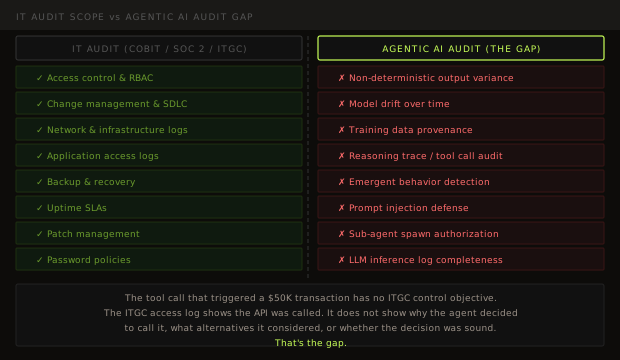
Non-determinism: The Same Input Does Not Produce the Same Output
Temperature and sampling in LLM inference mean that sending the exact same prompt to the same model version twice will produce different outputs. Not because of a bug. By design.
For a procurement approval agent that runs at temperature 0.7 to produce more "natural" reasoning, there is no such thing as a test case in the traditional sense. You can observe that the agent approved PO-7821 on Tuesday. You cannot replay that decision and guarantee the same result. The reasoning trace that led to approval is a sample from a probability distribution — it is not deterministic logic.
This has immediate audit implications. Change management controls assume you can test a change and verify its behavior. Regression testing assumes previous behavior is reproducible. Statistical reproducibility testing — running N samples and measuring variance — is not in any ITGC framework today. It is not in COBIT 2019. It is not in SOC 2.
The April 2026 Federal Reserve guidance SR 26-2 explicitly called this out: "agentic AI systems, by virtue of their non-deterministic reasoning processes, require validation methodologies distinct from those outlined in SR 11-7." That is the Fed telling banks that their existing model risk management framework — the one they have been working against since 2011 — does not cover agents. They have approximately 12 months to update their validation frameworks before examination teams start asking for evidence.
Tool Calls as Actions With Real-World Side Effects
An agent that browses the web, reads a file, and writes a summary is bounded. An agent that calls a payment API, updates a vendor record in Oracle Fusion, or sends an automated legal notice has caused effects in the real world that may be difficult or impossible to reverse.
The ITGC access log will show that the payment API endpoint was called. It shows the timestamp, the user principal (probably a service account), and the HTTP status code. What it does not show:
- What the agent was trying to accomplish when it made that call
- What alternatives it considered and rejected
- Whether the decision to call that specific tool at that moment was reasonable given the context
- What was in the agent's context window — the full set of information it was acting on
That reasoning layer — the layer between "input arrived" and "API was called" — is entirely invisible to ITGC. There is no control objective for it. There is no workpaper template for testing it. The AICPA's 2025 SOC 2 criteria update extended "Availability" to cover model inference availability and "Confidentiality" to cover training data provenance. It did not create a control category for inference-time reasoning auditability. That update has not even been enforced yet.
Sub-Agent Spawning: No Change Management Process Anticipated This
An orchestrator agent that spins up specialist sub-agents on demand creates a dependency chain that existing change management processes have no framework for. When the orchestrator decides at runtime to spawn a "compliance review agent" that has access to your contract management system, which change ticket authorized that? Which access review covers the sub-agent's permissions? When the sub-agent produces output that the orchestrator incorporates into a recommendation, which entity in your RACI matrix owns accountability for that recommendation?
SR 26-2 explicitly flagged this: hierarchical agent spawning creates accountability gaps that existing governance structures cannot resolve without new policy frameworks. The problem is not that organizations lack the will to govern this. It is that no one has written the governance playbook yet.
Persistent Memory: Context Window State Is Audit-Relevant
Agents with persistent memory across sessions — RAG retrievals, session summaries, user preference stores — are maintaining state between interactions. That state influences decisions. In a traditional application, the state that influenced a decision is captured in the database: you can query what the system knew at the time.
For an agentic system, the relevant state includes what was retrieved from the vector store, what was in the session context, and what the system prompt was instructing the agent to prioritize. None of that is captured by default. None of it is required by current frameworks. But all of it is directly relevant to whether a decision was sound.
What a Real Agentic Audit Looks Like
The minimum viable agentic audit trace — the floor of what SR 26-2's implicit guidance suggests you should be capturing — looks something like this:
# Minimal agentic audit trace — what SR 26-2 guidance implies you should capture
{
  "session_id": "agt_20260529_abc123",
  "agent_version": "procurement-agent-v2.1.3",
  "model": "gemini-2.0-flash",
  "model_hash": "sha256:a4f8c...",  # reproducibility — was this the validated version?
  "input": {"task": "approve purchase order #PO-7821", "amount_inr": 180000},
  "tool_calls": [
    {
      "tool": "lookup_vendor",
      "args": {"vendor_id": "V-291"},
      "result": "Approved vendor, last audit clean",
      "ts": "2026-05-29T14:32:01Z"
    },
    {
      "tool": "check_budget",
      "args": {"dept": "engineering", "amount": 180000},
      "result": "Within quarterly limit (₹8.2L remaining)",
      "ts": "2026-05-29T14:32:03Z"
    },
    {
      "tool": "approve_po",
      "args": {"po_id": "PO-7821"},
      "result": "Approved, reference TX-99201",
      "ts": "2026-05-29T14:32:05Z"  # SIDE EFFECT — real-world action
    }
  ],
  "reasoning_summary": "Vendor V-291 is pre-approved. Amount within engineering Q2 budget. No policy exceptions triggered. Approving.",
  "retrieved_context": ["vendor_policy_v4.pdf#section3", "budget_q2_2026.xlsx#row42"],
  "human_override_available": false,  # ← regulatory risk flag
  "confidence": 0.94,
  "model_temperature": 0.3
}
The approval happened. The PO is in the system. Without this trace, your audit evidence is: "the PO was approved by the procurement system." With this trace, you can ask:
- Was the vendor lookup running against current data or a stale cache?
- Was the budget check real-time or pre-fetched?
- Why was human override disabled for a ₹1.8 lakh decision?
- The model was at temperature 0.3 — if we re-run this at 0.0, do we get the same decision?
- The
model_hashshows this was the validated version — or doesn't, which is a finding.
That last question is the statistical reproducibility test that SR 11-7's successors will eventually require. The others are simply what a reasonable auditor would want to know. Today, no agent system captures this by default. None.
The Consulting Opportunity
At GT Bharat, the AI governance question I hear from clients is not about building AI. It is about trusting AI already in production. Who reviews the model's decisions? Where is the audit trail if the regulator asks? How do we know it is not drifting? How do we demonstrate to our board that this system is under control?
The EY AI Audit Service launch in 2025 — the first Big 4 dedicated offering specifically for AI systems — is the first signal that the advisory market has clocked this gap. The Gartner AI governance platform market is at $492M in 2026, growing 38% year-over-year. That is not a market created by demand for rebadged ITGC work. That is enterprises recognizing they have a controls problem they do not know how to solve.
The firms that build real AI audit depth in 2026 and 2027 — ML validation methodology, reasoning trace review, agent behavior baselining, adversarial testing for agentic systems — will own this practice area for a decade. The work requires a combination of IT audit methodology, ML engineering knowledge, and regulatory interpretation that does not exist as a packaged service anywhere yet.
This is not a new service line that competes with existing IT audit work. It is a necessary extension of existing work that clients are already asking for and no one is systematically delivering.
AuditForge: A Deterministic Case Study That Proves the Point
When I built AuditForge — a deterministic, zero-AI config audit tool for Oracle Fusion — the hardest part was not the matching algorithm. It was designing the audit trail. Every match in AuditForge has a method signature: Exact | Normalized | Manual Alias | Fuzzy (score: 87). That method signature is the audit evidence. A regulator or client looking at a finding can see not just what matched, but how it matched, with what confidence, and why that confidence level is acceptable.
AuditForge has zero LLMs in its critical path precisely because the match method must be reproducible and reviewable by a regulator. The same principle applies to agentic systems: every significant decision needs a traceable "match method" — a human-readable explanation of why the agent chose that action. That is not a logging feature. That is an architecture requirement. You cannot retrofit it after the system is in production without rebuilding the decision path.
Now consider the same problem for an agentic system where the "method" is a 70-billion-parameter model's probability distribution over next tokens. The match method is not Fuzzy (score: 87). It is transformer attention + sampling from softmax at temperature 0.7. That is not meaningfully auditable with current tools. Building the infrastructure to make it auditable — the inference logs, the reasoning summaries, the model version pins, the adversarial baselines — is the architecture work that audit frameworks will eventually mandate and that clients need done now.
What Consulting Firms Need to Build
The path from "we have AI in production" to "we have auditable AI in production" requires six concrete capabilities that currently exist nowhere as a standard offering:
1. AI inventory before anything else. You cannot govern what you have not mapped. Most organizations have AI running in production in forms that are not recognized as AI: scoring models baked into SaaS tools, LLM-powered features in platforms they did not build. The inventory — what models, what versions, what data, what decisions — is the prerequisite for everything else.
2. Internal model risk tiers — not just EU AI Act categories. The EU AI Act's prohibited/high-risk/limited-risk/minimal-risk taxonomy is a regulatory floor, not an internal governance framework. A proprietary procurement agent may not be "high risk" under the Act but may still require internal validation because it controls significant spend. Build the internal tier matrix that maps model type × decision consequence × reversibility to required controls.
3. Inference logging infrastructure. The reasoning trace — not just the input/output, the full tool call sequence with timestamps and arguments — needs to be captured at the infrastructure layer, not the application layer. Application-layer logging will be inconsistent across agent implementations. The platform layer needs to emit structured audit events for every model invocation.
4. Validation methodology for non-deterministic systems. Statistical reproducibility testing: run the same prompt N times at temperature 0, measure output variance, establish a baseline. Challenger model testing: when you swap model versions, do decision distributions shift significantly? These are adaptations of existing SR 11-7 challenger model concepts applied to agentic systems.
5. Adversarial testing baseline for agents. Red-teaming for agentic systems is different from red-teaming for static models. The adversarial surface includes prompt injection via tool outputs, indirect injection via retrieved documents, sub-agent hijacking, and context poisoning across sessions. A baseline adversarial test suite needs to exist before an agent goes to production.
6. Human escalation protocols — what decisions require a human in the loop. This is the control that most current agentic deployments are missing and that SR 26-2 implicitly requires. The decision matrix: what action types, above what consequence threshold, with what reversibility profile, require a human approval step? This is a policy document that feeds into agent system prompt design and is auditable as a control.
The IT Audit vs AI Audit Gap
The ISACA and COBIT Response
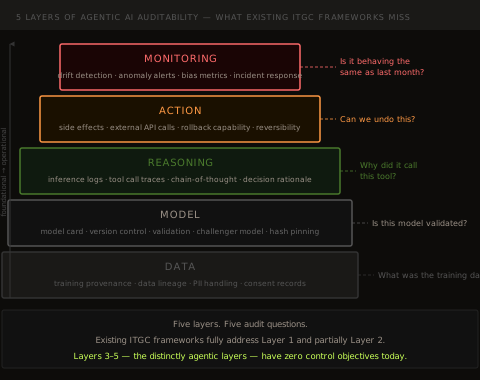
ISACA's COBIT AI edition (v2026 preview) adds an "AI Governance" domain with 8 sub-objectives. This is encouraging as a signal and insufficient as a framework. The sub-objectives cover AI strategy, model inventory, and responsible AI principles at the governance layer. They do not reach into inference-time auditability, adversarial testing methodology, or agentic-specific controls. The framework is catching up to where the technology was in 2023.
The AICPA's SOC 2 Trust Services Criteria update — extending Availability to cover model inference availability and Confidentiality to cover training data provenance — is similarly directional but not yet enforced and not yet agentic-aware. It covers the data and model layers. It does not cover the reasoning and action layers that are unique to agentic architectures.
The regulatory framework is moving. It is moving more slowly than the technology. The consulting opportunity is in the gap between where the regulation will eventually land and where enterprises need to be before it gets there.
The Closing Argument
The gap is not a compliance problem. It is an architecture problem masquerading as a compliance problem.
Organizations that wait for the regulation to arrive and then retrofit auditability into production agent systems will find that retrofitting requires rebuilding significant parts of the inference infrastructure. The reasoning trace is not a feature you add. It requires that the agent's decision process emit structured events at every step — tool selection, tool execution, context retrieval, confidence estimation. Systems not designed for this will need to be redesigned.
The firms that get ahead of this are not doing compliance for its own sake. They are building the audit architecture into the agent architecture from day one — so that when SR 26-2's successor arrives with enforcement teeth, they already have the evidence package. That is a materially different position than discovering the gap during a regulatory examination.
The next compliance cycle will ask: show me the reasoning trace for that agent decision. Most organizations running agentic AI in production today cannot answer that question. That is the problem. It is also the practice area.